Business Watch: Choosing the Best Commercial Security
Video surveillance for businesses: Ultimate 2025 Guide
Why Video Surveillance for Businesses is Essential Today
Video surveillance for businesses is a critical investment for protecting assets, reducing losses, and improving operations. The benefits are significant:
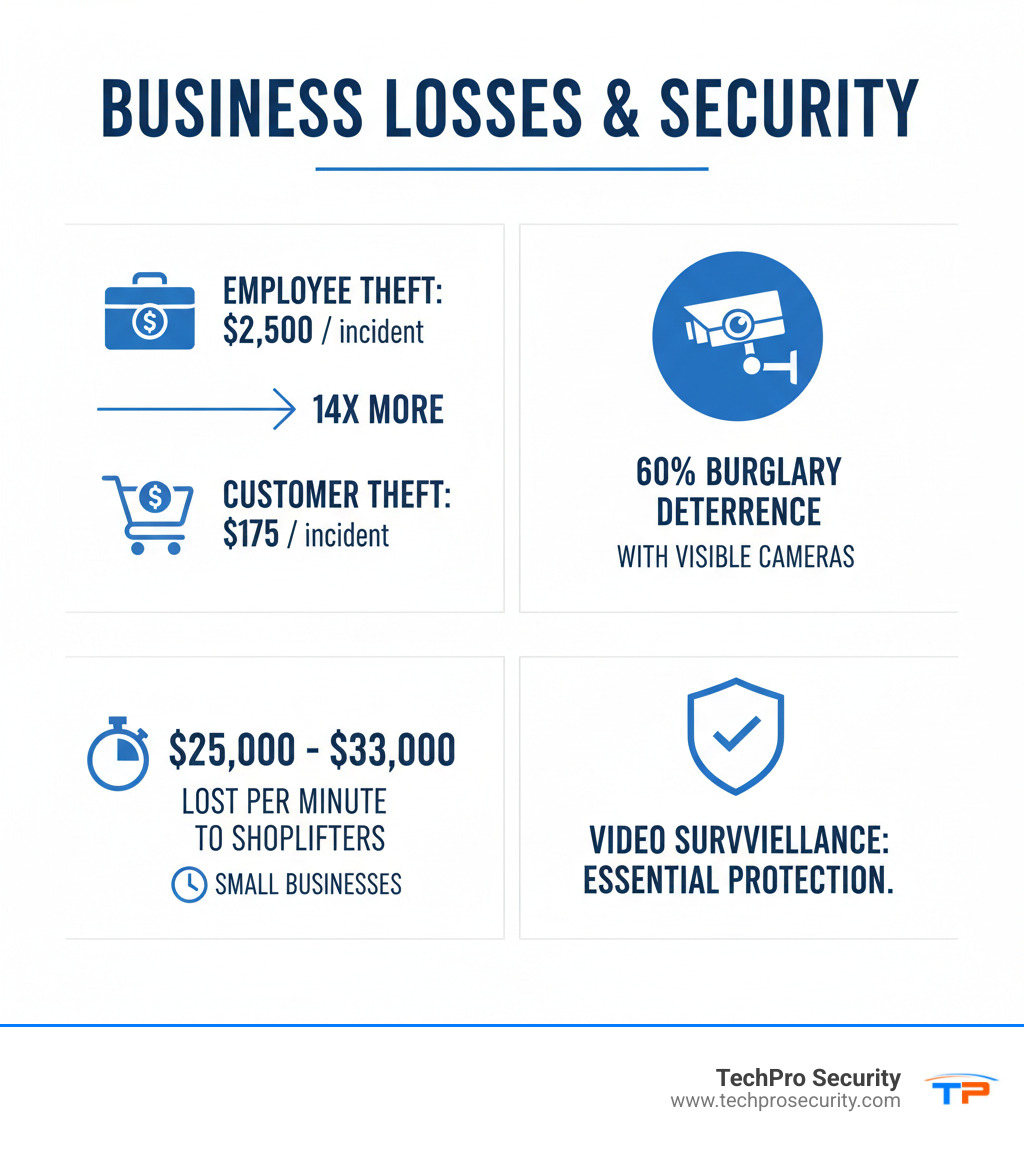
- Deters Crime: Visible cameras deter about 60% of burglaries.
- Reduces Theft: Addresses costly employee theft (averaging $2,500 per incident) and shoplifting.
- Improves Operations: Improves productivity and provides evidence for claims and investigations.
- Enables Remote Monitoring: Allows you to watch over your business from anywhere.
The reality is stark: businesses often lose more to internal theft than external crime. A comprehensive security strategy with smart cameras and proper data management is essential for protecting your bottom line.
Modern systems offer AI-powered analytics, cloud storage, and remote access, changing how you manage and protect your business. I’m Brad Besner, founder of TechPro Security Products. With over 15 years of experience designing custom video surveillance for businesses in South Florida, I’ll guide you through choosing the right system.
Why Your Business Needs Video Surveillance
A well-designed video surveillance for businesses system does more than record footage—it actively protects your investment and helps your operation run smoothly. The numbers tell an important story: businesses lose more to employee theft (averaging $2,500 per incident) than to typical shoplifters ($175 per incident). This highlights the need for a security approach that addresses both internal and external threats.
Visible cameras are a powerful deterrent, preventing about 60% of burglaries before they happen. Considering small businesses can lose thousands per minute to shoplifters, prevention is a significant advantage. For more on internal losses, see the impact of employee theft. Combining video surveillance with other measures like our security alarm services creates layered defense, as confirmed by studies on deterring burglaries. Beyond theft, modern systems protect against liability claims, document workplace accidents, and prevent fraud.
Deterring External and Internal Threats
The most obvious benefit of security cameras is deterring external threats like shoplifting, burglary, and vandalism. Strategically placed cameras send a clear message that your business is not an easy target. If a crime does occur, you have high-quality footage for law enforcement.
Internal threats are often more costly. When employees know cameras are monitoring high-value areas like cash registers, inventory rooms, and loading docks, they are far less likely to engage in misconduct. This isn’t about distrust; it’s about accountability and protecting honest employees from false accusations. Point-of-sale monitoring is especially crucial, as it links every transaction to video, helping you quickly spot suspicious patterns like fake returns or unauthorized discounts. Footage can also help investigate non-theft discrepancies, such as inventory mistakes, allowing you to fix processes without placing blame.
Enhancing Operational Efficiency and Safety
Modern video surveillance for businesses is also a powerful tool for improving operations. By analyzing customer traffic flow, you can optimize store layouts, adjust staffing, and improve product placement. It’s like having a business consultant watching your operation 24/7.
For businesses with physical hazards like warehouses or construction sites, cameras help ensure safety protocols are followed. You can monitor dangerous zones and verify the use of protective equipment. If an accident occurs, the footage provides a clear record for insurance claims and helps prevent future incidents.
Remote management is a game-changer for owners with multiple locations. Instead of driving all over South Florida, you can view live feeds from your phone or computer, verifying incidents and checking on operations from anywhere. Our video monitoring services can provide professional oversight when you can’t watch everything yourself. A good surveillance system protects your assets, people, and peace of mind, making it a vital investment in your business’s future.
A Buyer’s Guide to Commercial Security System Components
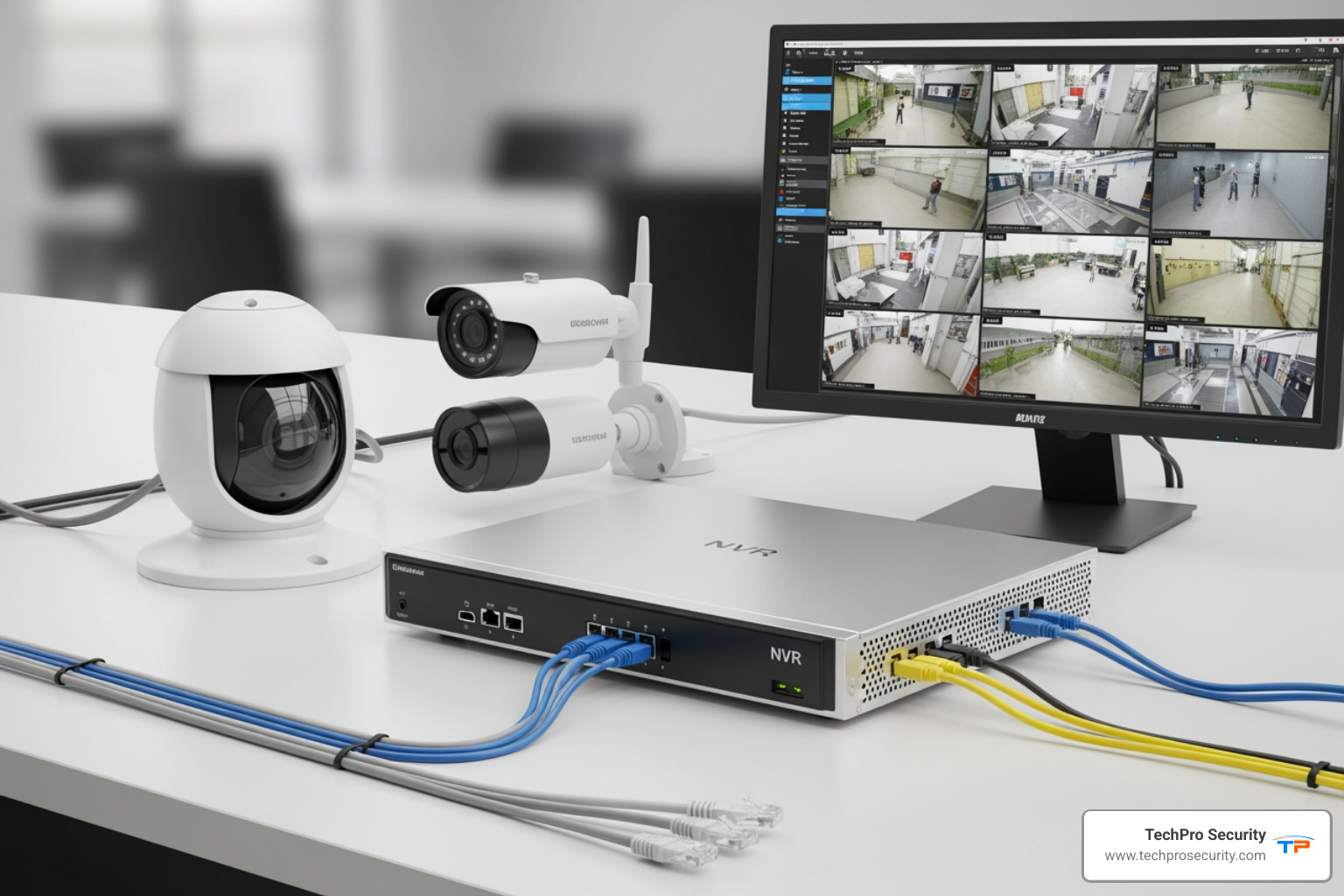
Understanding the components of a video surveillance for businesses system helps you make smarter decisions. A commercial system has four core parts: cameras to capture video, video recorders (NVRs/DVRs) to store it, video management software to view and analyze it, and the cabling/network infrastructure to connect it all. Choosing the right combination depends on your specific needs, as a small boutique in Coral Gables has different requirements than a large warehouse in Homestead.
Choosing the Right Cameras for Your Business
One size does not fit all when it comes to cameras. We focus on four key features:
- Resolution: Determines image clarity, from 1080p for general use to 4K+ for capturing fine details like faces or license plates.
- Field of View: Defines the coverage area, from narrow views for cash registers to wide angles for parking lots.
- Night Vision: Essential for 24/7 protection, typically using infrared (IR) to see in total darkness. Some models offer color night vision.
- Weatherproofing & Durability: Look for IP66/IP67 ratings to withstand South Florida’s weather and IK10 vandal-proof ratings for high-risk areas.
Common camera types include:
- Dome Cameras: Discreet and tamper-resistant, ideal for indoor or outdoor use where you don’t want obtrusive cameras.
- Bullet Cameras: Highly visible for strong deterrence, excellent for long-range outdoor surveillance like perimeters and parking lots.
- PTZ (Pan-Tilt-Zoom) Cameras: Allow active monitoring, as operators can remotely pan, tilt, and zoom to follow activity in large areas like warehouses.
- Fisheye & Panoramic Cameras: Provide 360-degree coverage from a single point, eliminating blind spots in large open spaces like retail floors or lobbies.
Our security camera installation services ensure we design a camera layout that makes sense for your specific operations.
Video Storage Solutions for Business Video Surveillance
Choosing where to store footage is a critical decision. Your main options are on-premise, cloud, or a hybrid approach.
On-premise storage uses a Network Video Recorder (NVR) for modern IP cameras or a Digital Video Recorder (DVR) for older analog cameras. The main benefits are full data control and no monthly fees. The downside is the physical recorder is vulnerable to theft or damage, and you are responsible for maintenance.
Cloud storage uploads footage to secure remote servers, making it accessible from anywhere and safe from on-site disasters. It’s highly scalable, but requires a reliable internet connection and involves ongoing subscription costs.
Hybrid storage offers the best of both worlds, recording continuously to a local NVR while backing up critical events to the cloud. This provides redundancy and remote access without the high bandwidth demands of full cloud recording. It’s the solution we most often recommend.
Feature Local Storage (NVR/DVR) Cloud Storage Hybrid Storage
Cost Higher upfront (hardware), lower ongoing Lower upfront, higher ongoing (subscription) Balanced
Accessibility On-site access, limited remote via network Remote access from anywhere Remote access, local redundancy
Security Physical security of device, vulnerability to theft/damage Off-site, encrypted, redundant servers Combines local and remote security
Scalability Limited by recorder capacity, requires hardware upgrade Highly scalable, pay-as-you-grow Flexible, combines best of both
Bandwidth Minimal impact on internet for recording Requires stable, high-bandwidth internet Moderate impact
Control Full control over data Relies on provider Shared control
Data retention—how long you keep footage—typically ranges from 30 to 90 days, depending on industry regulations and storage capacity. For robust storage solutions, our cloud backup and storage options provide enterprise-level protection.
The Evolution of Business Video Surveillance Technology
Early CCTV systems were a far cry from today’s technology. They were analog, low-resolution, and required someone to physically watch monitors. Scaling was difficult, and remote access was non-existent. The shift to digital IP (Internet Protocol) systems revolutionized video surveillance for businesses by transmitting video as data over a network.
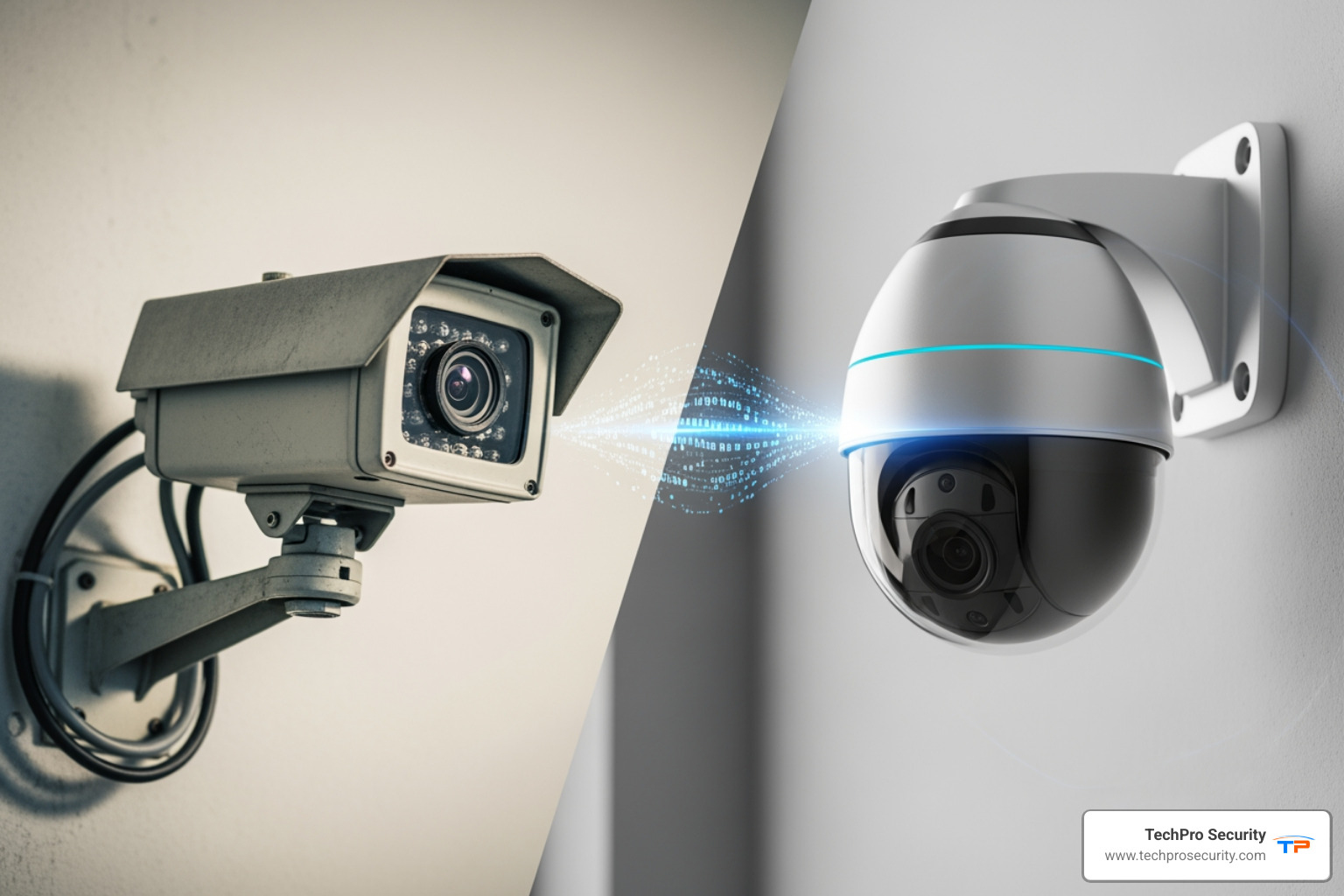
This change brought immense benefits: higher resolution (HD, 4K, and beyond) for clear, usable evidence; standard remote access to check on your business from anywhere; and far greater scalability, as adding cameras often just means plugging them into your network. Modern cloud-based systems further improve this by offloading storage and processing, making systems more resilient and accessible.
The Power of AI and Advanced Video Analytics
Today’s intelligent systems use Artificial Intelligence (AI) and computer vision to analyze video in real-time, turning cameras from passive recorders into active intelligence tools. Instead of manually scrubbing through hours of footage, AI does the heavy lifting.
Key AI capabilities include:
- AI-Powered Search: Instantly find footage of specific people or vehicles (e.g., search for “white delivery truck”) instead of watching hours of video.
- People & Vehicle Detection: The system distinguishes between people, vehicles, and other objects, reducing false alarms from things like animals or blowing debris.
- License Plate Recognition (LPR): Automatically read and log license plates of vehicles entering or exiting your property. We offer specialized license plate recognition systems for this purpose.
- Occupancy Trends & Heat Mapping: Analyze foot traffic to optimize retail layouts, staffing, and product placement.
These analytics dramatically reduce false alarms by learning what’s normal for your environment and alerting you only to genuine concerns.
Integrating Surveillance with Other Business Systems
The most effective security platforms unify your video surveillance for businesses with other operational tools. This integration allows your system to respond intelligently to events.
- Access Control Integration: When someone uses a badge, the system can link the event to video from the nearest camera. Our access control systems create a visual record of who enters and when.
- Alarm System Integration: When a sensor is triggered, cameras can automatically focus on that area and send real-time video clips to security personnel.
- Point-of-Sale (POS) Integration: This is a game-changer for retail and restaurants. Every transaction is linked to video, making it easy to investigate suspicious voids, returns, or cash shortages.
Modern systems also offer APIs (Application Programming Interfaces) for custom integrations, allowing you to build a centralized platform where all your security and operational systems work together seamlessly.
Planning and Implementing Your System
Properly implementing a video surveillance for businesses system requires careful planning. The process should always start with a professional consultation and site assessment to understand your unique security concerns, identify vulnerable areas, and note challenging lighting or architectural conditions. From there, a customized system design is developed, mapping out camera types, recording solutions, and integration opportunities. A clear budget should account for all costs, including hardware, professional installation, software, and ongoing maintenance. Finally, professional installation ensures cameras are correctly positioned and configured, followed by comprehensive training for you and your team.
Key Considerations for Installation and Placement
Strategic camera placement is everything. Even the best cameras are useless if they’re pointed at the wrong spots. Here are the essentials:
- Cover all entry and exit points to create an accountability trail of everyone coming and going.
- Monitor high-risk zones with clear, well-lit coverage. This includes cash registers, inventory storage, server rooms, and safes.
- Use outdoor cameras to deter criminals before they act and indoor cameras to supervise operations and protect valuable assets.
- Respect privacy. Cameras should never be placed in restrooms, changing rooms, or other areas where there is a reasonable expectation of privacy. This is a legal and ethical requirement.
While DIY systems exist, professional installation is critical for businesses. Technicians optimize camera angles, secure mounting to prevent tampering, and ensure seamless network integration. For more on this, see this article on the importance of camera placement. Regular upkeep is also vital; our security system maintenance services keep your system running smoothly.
Legal and Privacy Compliance for Business Video Surveillance
Navigating the legal landscape for video surveillance for businesses is manageable if you follow key principles. We help clients implement systems that are both powerful and compliant.
- Be Transparent: You must inform employees and customers that they are being recorded. Prominently display clear signage at all entrances.
- Protect Data: Securely store footage with access limited to authorized personnel. Use recordings only for their stated purpose (e.g., security).
- Respect Employee Privacy: Avoid surveillance in areas like break rooms without clear justification and a written company policy. Never use hidden cameras.
- Avoid Audio Recording: Florida is an all-party consent state, making it illegal to secretly record conversations. We almost always advise against audio recording due to the high legal risks.
- Establish Data Policies: Create clear rules for how long you will retain footage before securely deleting it and have a process for handling requests from individuals to access footage of themselves.
For specific legal advice, always consult a qualified attorney. General best practices can be found in resources like these guidelines on video surveillance.
Frequently Asked Questions about Commercial Security Cameras
Over my years helping South Florida business owners, certain questions about video surveillance for businesses come up repeatedly. Here are the most common ones.
How many security cameras does my business need?
There’s no single answer, as every business is unique. The right number depends on several factors: business size and layout, the location of your high-risk areas (entrances, cash registers, inventory), and your budget. It’s often better to perfectly cover critical zones first and then expand later. Complex layouts with more blind spots will require more cameras than open-plan spaces. The best way to determine the exact number is with a professional assessment, where we can identify vulnerabilities and design a layout custom to your operations.
Can I view my business security cameras remotely?
Yes, absolutely. Modern IP camera systems offer robust remote access through user-friendly mobile apps and web-based portals. You can view live feeds, review recorded footage, and receive alerts on your smartphone, tablet, or computer from anywhere in the world. This is a standard feature of modern surveillance and one of the key IP camera benefits. We ensure your network is securely configured to protect your remote access. For owners of multiple locations, this capability is invaluable for monitoring all properties from a single interface.
How long should a business keep security footage?
Determining your data retention period is a balance of practical and legal considerations. You must adhere to any industry regulations or legal requirements that apply to your business. From a practical standpoint, you need to keep footage long enough to investigate incidents that may not be finded immediately. Your storage capacity—whether local or cloud-based—will also be a deciding factor.
For most businesses, typical retention periods are between 30 and 90 days. This window usually covers most investigation timelines without incurring excessive storage costs. We help you establish a data retention policy that balances security needs, compliance, and budget.
Secure Your Business with a Professional Surveillance System
As we’ve covered, modern video surveillance for businesses is an intelligent system that deters crime, improves safety, and provides valuable operational insights. With AI analytics, cloud storage, and seamless integration, the right system is a powerful tool for protecting your assets.
However, technology alone isn’t enough. A system must be properly designed, installed, and maintained for your specific environment to be effective. This is where a professional partner makes all the difference.
At TechPro Security, we have over 15 years of experience protecting businesses across South Florida, from Miami to West Palm Beach. We don’t use cookie-cutter solutions. Our team provides a custom design based on a thorough site assessment of your property’s unique needs and budget. We handle everything from installation to ongoing maintenance, backed by extensive warranties and free US-based support.
Don’t wait for an incident to happen. A professional surveillance system is one of the smartest investments you can make in your business’s security and success. Take the proactive step to safeguard your assets, team, and peace of mind.
Get a professional security camera installation quote from TechPro Security and experience the difference expert protection can make.