Biometric Access Control Installation | South Florida
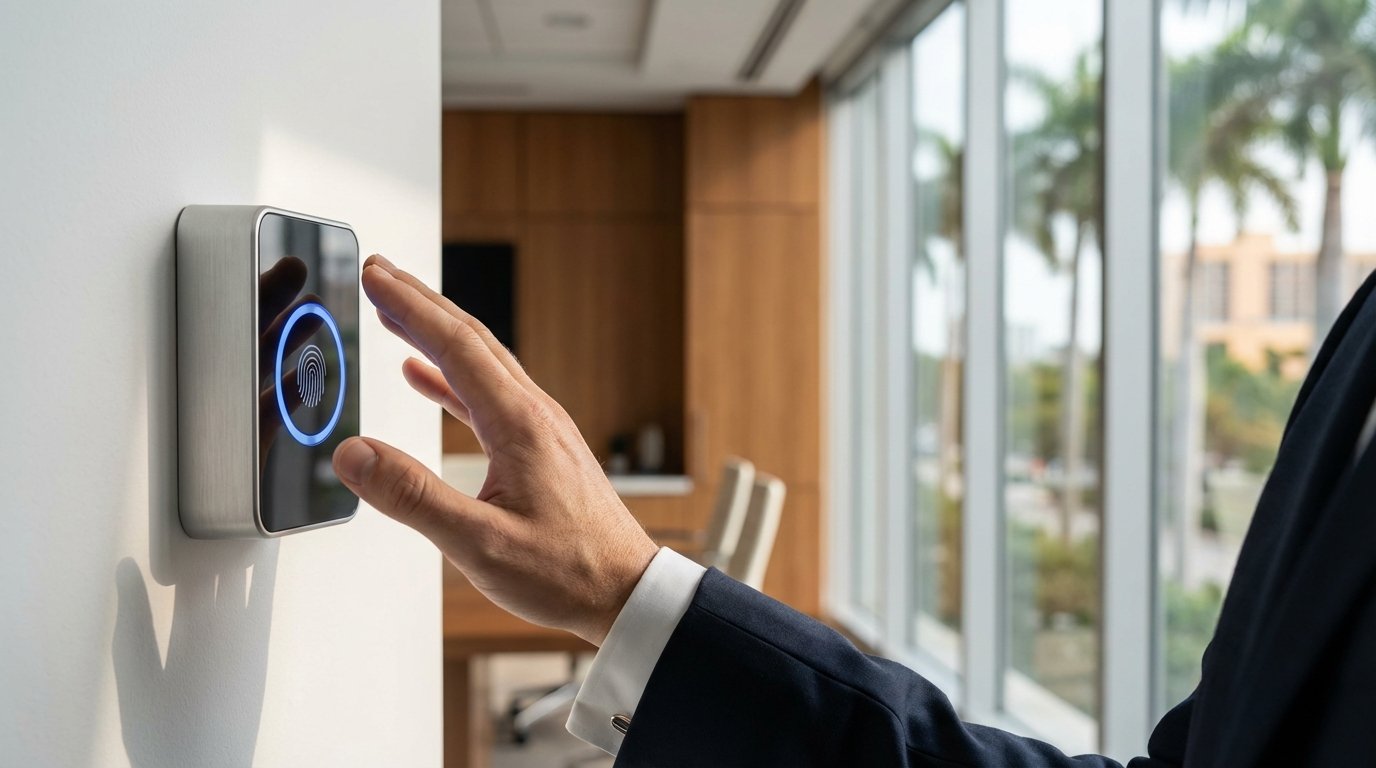
Outdated key cards, forgotten PINs, and lost credentials create daily security headaches for South Florida businesses. A recent security industry report found that 68% of corporate data breaches involve compromised credentials—making traditional access control methods increasingly risky in 2026. Biometric access control installation eliminates these vulnerabilities by authenticating individuals based on unique physical characteristics that can’t be shared, stolen, or forgotten.
As South Florida’s business landscape grows more competitive and security threats evolve, companies from Miami to West Palm Beach are upgrading to biometric systems that offer precision, accountability, and seamless integration with existing security infrastructure. This guide examines the technologies, implementation processes, and business benefits that make biometric access control the intelligent choice for protecting your facilities, assets, and personnel.
Understanding Biometric Access Control Technology
Biometric access control installation replaces traditional authentication methods with biological identification systems. Instead of presenting a card or entering a code, authorized personnel gain entry through fingerprint scans, facial recognition, iris patterns, or other unique physical traits.
Modern biometric systems capture biological data, convert it into digital templates, and store these encrypted patterns in secure databases. When someone requests access, the system compares their live biometric sample against stored templates, granting entry only when a match is confirmed within milliseconds.
The technology operates through three core components:
Biometric readers serve as the capture devices installed at entry points. These specialized sensors collect biological data—whether fingerprints, facial images, or iris patterns—and convert physical characteristics into digital information.
Control panels function as the system’s processing brain, managing authentication requests, comparing biometric data against stored templates, and triggering door locks based on verification results.
Management software provides administrators with centralized control over user enrollment, access permissions, audit trails, and system configuration across single or multiple locations.
Unlike conventional access control systems for small businesses that rely on possessions or knowledge, biometric authentication verifies identity based on who you are—creating an authentication method that cannot be borrowed, duplicated, or transferred.
Five Biometric Technologies Transforming Business Security
1. Fingerprint Recognition Systems
Fingerprint scanners represent the most widely deployed biometric technology for commercial applications. These readers analyze the unique ridge patterns, minutiae points, and characteristics of fingertips to verify identity.
Modern optical and capacitive fingerprint sensors deliver accuracy rates exceeding 99%, with authentication speeds under one second. Installation costs range from $1,200 to $3,500 per door, depending on reader quality and integration requirements.
Fingerprint systems excel in moderate-traffic environments like office suites, server rooms, and executive areas where employees need frequent access. South Florida’s humidity can occasionally affect optical readers, making capacitive models a reliable choice for coastal locations.
2. Facial Recognition Access Control
Facial recognition systems analyze geometric facial features, distances between key points, and unique characteristics to authenticate individuals. Advanced algorithms in 2026 models can identify authorized personnel even with facial hair changes, glasses, or masks.
These contactless systems offer significant advantages in high-traffic areas and post-pandemic environments where employees prefer touchless entry. Readers mounted at doorways authenticate approaching personnel automatically, creating seamless entry experiences.
Implementation costs typically range from $2,500 to $6,000 per access point, with higher prices reflecting advanced AI capabilities and environmental adaptability. Facial recognition integrates naturally with existing video surveillance infrastructure, often utilizing the same network and power supplies.
The technology performs exceptionally well in corporate lobbies, research facilities, and healthcare environments requiring both security and convenience. South Florida businesses appreciate the contactless nature during humid months when touching shared surfaces becomes uncomfortable.
3. Iris Scanning Technology
Iris recognition analyzes the complex patterns in the colored ring surrounding the pupil. These patterns contain approximately 266 unique characteristics—significantly more than fingerprints—making iris scanning the most accurate biometric method available.
With false acceptance rates approaching one in several million, iris scanning suits high-security applications like pharmaceutical laboratories, data centers, financial institutions, and government facilities. The technology works reliably regardless of weather conditions, hand cleanliness, or physical contact concerns.
Installation costs range from $4,000 to $8,000 per reader, reflecting the sophisticated imaging technology required. While more expensive than fingerprint or facial systems, iris scanning delivers unmatched accuracy for environments where security compromise carries severe consequences.
4. Palm Vein Recognition
Palm vein systems use near-infrared light to capture the unique vein patterns beneath palm skin. Because these patterns exist internally and require blood flow for detection, palm vein technology resists spoofing attempts that might fool surface-based biometrics.
This contactless technology combines high accuracy with hygiene benefits, making it ideal for healthcare facilities, food processing plants, and cleanroom environments. Authentication occurs when users hold their palm above or near the reader without physical contact.
Installation costs typically fall between $3,000 and $6,500 per access point. The technology’s ability to work reliably with wet or dirty hands makes it particularly suitable for South Florida warehouses and industrial facilities.
5. Multi-Modal Biometric Systems
Multi-modal systems combine two or more biometric technologies—such as fingerprint plus facial recognition—to achieve maximum security. By requiring multiple biometric confirmations, these systems virtually eliminate unauthorized access while maintaining reasonable authentication speeds.
Government facilities, critical infrastructure sites, and businesses handling sensitive intellectual property increasingly deploy multi-modal systems. The redundancy also ensures access continuity if environmental conditions temporarily affect one biometric method.
Implementation costs range from $5,000 to $12,000 per access point depending on the technologies combined. While representing significant investment, multi-modal systems deliver security levels appropriate for the most sensitive applications.
The Professional Installation Process
Successful biometric access control installation follows a structured methodology that ensures reliable operation and seamless integration with existing security infrastructure.
Site Assessment and Requirements Analysis
Professional installation begins with comprehensive site evaluation. Security specialists examine your facilities to identify critical access points, assess network infrastructure, evaluate power availability, and understand traffic patterns. This assessment determines which biometric technologies best match your operational requirements and budget constraints.
During this phase, installers also review integration needs with existing systems—whether video surveillance, intrusion detection, or visitor management platforms. For businesses operating across multiple South Florida locations, specialists design unified systems that centralize management while accommodating site-specific requirements.
System Design and Specification
Based on assessment findings, experienced access control installation companies develop detailed system designs specifying reader locations, network architecture, server requirements, and software configurations. These designs address scalability to accommodate future growth and technology upgrades.
Professional designs also incorporate redundancy for mission-critical access points and establish backup authentication methods for emergency situations. The specification phase determines exact equipment models, quantities, and infrastructure modifications required for installation.
Infrastructure Preparation
Before installing biometric readers, technicians prepare the physical and network infrastructure. This involves running network cables, installing power supplies, mounting control panels, and configuring network switches for the additional devices.
For retrofits into existing buildings, installers often leverage Power over Ethernet (PoE) technology to simplify wiring by delivering both data and power through single network cables. Professional installers ensure all cabling meets commercial standards and local building codes.
Reader Installation and Configuration
Technicians mount biometric readers at optimal heights and positions for reliable operation. Fingerprint readers typically install at 48 inches above floor level, while facial recognition cameras position to capture approaching personnel at natural angles.
After physical installation, specialists configure each reader with network settings, security parameters, and communication protocols. Integration with central management software establishes the foundation for user enrollment and access control policies.
User Enrollment and Database Setup
Enrolling authorized personnel represents a critical implementation phase. Administrators capture biometric samples from each employee, associate these templates with user profiles, and assign appropriate access permissions based on job roles and security clearances.
Professional enrollment processes capture multiple biometric samples to ensure accuracy and accommodate variations in presentation. The resulting database contains encrypted templates that enable rapid authentication while protecting employee privacy.
Integration Testing and Validation
Before going live, installers conduct comprehensive testing to verify system performance. This includes authentication speed testing, failover testing, network reliability validation, and integration confirmation with connected security systems.
Testing also validates that audit logging functions properly, capturing entry attempts, access grants, denials, and system events. Professional installers document all testing results and adjust configurations to optimize performance.
Training and Documentation
Successful installations conclude with administrator training covering user management, access policy configuration, report generation, and troubleshooting procedures. Employees receive orientation on proper biometric presentation techniques to ensure smooth daily operation.
Professional installers provide comprehensive documentation including system diagrams, configuration settings, user manuals, and maintenance schedules. This documentation proves essential for ongoing system management and future expansions.
Seven Business Benefits of Biometric Access Control
1. Elimination of Credential Sharing
Biometric authentication completely prevents the credential sharing that undermines traditional access control security. Employees cannot loan their fingerprints or faces to unauthorized individuals, ensuring that only specifically authorized personnel enter restricted areas.
This benefit proves particularly valuable in environments like warehouse security systems where inventory shrinkage and after-hours access represent significant concerns.
2. Enhanced Accountability and Audit Trails
Biometric systems create indisputable records of who accessed specific areas at precise times. This accountability transforms security investigations and compliance reporting by eliminating questions about credential usage.
South Florida businesses subject to regulatory compliance—including healthcare facilities, financial institutions, and government contractors—find that biometric audit trails streamline compliance documentation and reduce liability exposure.
3. Reduced Administrative Overhead
Biometric credentials never require replacement due to loss, theft, or damage. Administrators no longer manage physical key cards, reset forgotten PINs, or maintain inventory of access credentials. This administrative efficiency translates directly into reduced security management costs.
When employees separate from the organization, administrators simply disable their biometric template in the database—eliminating concerns about unreturned credentials or unauthorized access through retained physical keys.
4. Faster Authentication and Improved Traffic Flow
Modern biometric readers authenticate personnel in under one second, often faster than card-based systems. This speed maintains security while improving employee experience, particularly during shift changes when multiple personnel access facilities simultaneously.
For businesses like retail stores with back-office access or employee-only areas, biometric systems eliminate the delays associated with searching for access cards or remembering codes.
5. Integration with Comprehensive Security Platforms
Professional biometric access control installation integrates seamlessly with video surveillance, intrusion detection, and visitor management systems. This integration enables sophisticated security responses—such as automatically displaying video from specific cameras when access is granted or denied at monitored doors.
Integration also supports advanced features like automatic lockdown during security incidents, scheduled access modifications based on business hours, and coordinated responses across multiple security subsystems.
6. Scalability Across Multiple Locations
Cloud-based biometric access control platforms enable South Florida businesses operating across multiple locations to manage security from centralized interfaces. Administrators in Miami can enroll users, adjust permissions, and review audit logs for facilities throughout the region.
This scalability proves essential for growing businesses that need consistent security policies across expanding operations without proportionally increasing security staff.
7. Long-Term Cost Effectiveness
While biometric systems require higher initial investment than traditional card readers, they deliver superior total cost of ownership through eliminated credential replacement costs, reduced administrative time, and decreased security incidents. Most commercial installations achieve positive ROI within 24-36 months.
The durability of professional-grade biometric readers—often exceeding ten years of reliable operation—further enhances long-term cost effectiveness compared to systems requiring frequent component replacement.
Implementation Costs and Budget Planning
Understanding the investment required for biometric access control installation helps businesses plan appropriately and evaluate return on security investment.
Equipment Costs
Biometric readers represent the largest equipment expense, ranging from $600 to $3,000 per unit depending on technology type and manufacturer. Fingerprint readers occupy the lower end of this spectrum, while advanced iris scanners command premium prices.
Control panels cost between $800 and $2,500 each, with capacity varying from four to thirty-two doors per panel. Door strikes, magnetic locks, and related hardware add $150 to $400 per door.
Management software licensing varies significantly based on system capacity and features. Expect costs from $1,200 to $5,000 for initial licenses, with annual maintenance fees of 15-20% of purchase price.
Professional Installation Labor
Professional installation labor typically represents 30-50% of total project costs. For a single-door installation, expect labor costs of $800 to $1,500. Multi-door projects benefit from economies of scale, with per-door installation costs decreasing as project size increases.
Complex installations requiring extensive infrastructure modifications, integration with legacy systems, or specialized mounting conditions command higher labor costs but ensure reliable long-term operation.
Ongoing Operational Costs
Annual maintenance agreements from professional access control installation companies typically cost 12-18% of initial equipment value. These agreements include software updates, technical support, and priority service for hardware issues.
Electricity costs for biometric systems remain minimal, typically under $15 annually per reader when utilizing efficient PoE technology. Network bandwidth requirements also remain modest, posing no burden on commercial internet connections.
Total Investment Examples
A small office securing three doors with fingerprint readers can expect total investment of $6,500 to $12,000 including equipment, installation, and initial configuration.
Medium businesses protecting ten access points across a single facility typically invest $20,000 to $45,000 for comprehensive biometric systems with centralized management.
Large enterprises deploying biometric access control across multiple South Florida locations with dozens of secured entrances may invest $75,000 to $200,000+ depending on technology choices, integration requirements, and facility complexity.
Selecting the Right Biometric Technology
Choosing appropriate biometric technology requires matching system capabilities with your specific security requirements, operational environment, and budget constraints.
Security Level Requirements
High-security environments like pharmaceutical research labs, financial institutions, and data centers benefit from iris scanning or multi-modal systems offering the lowest false acceptance rates. Moderate-security applications like general office access perform well with fingerprint or facial recognition technology.
Environmental Conditions
South Florida’s coastal environment influences technology selection. Capacitive fingerprint readers outperform optical models in humid conditions. Facial recognition systems excel in well-lit areas but may require infrared capabilities for dimly-lit access points. Consider environmental factors specific to each access point location.
Traffic Volume and Speed Requirements
High-traffic entrances serving hundreds of daily authentications benefit from facial recognition systems offering touchless, walk-through authentication. Lower-traffic executive areas or server rooms function efficiently with fingerprint readers requiring momentary stops.
Hygiene and User Preference
Post-pandemic awareness makes contactless biometric technologies increasingly preferred. Facial recognition, iris scanning, and palm vein systems address hygiene concerns while maintaining security effectiveness. Survey employee preferences during the planning phase to enhance system acceptance.
Integration Requirements
Businesses with existing parking garage security systems or comprehensive video surveillance may prioritize biometric technologies that integrate seamlessly with current infrastructure. Professional installation companies assess compatibility during system design to ensure cohesive security platforms.
Budget Constraints
Organizations with limited budgets can phase biometric implementation by initially securing the most critical access points with advanced technology while using traditional methods elsewhere. This staged approach delivers immediate security improvements for sensitive areas while spreading investment over multiple budget cycles.
Working With Professional Installation Companies
Successful biometric access control installation depends heavily on selecting experienced, qualified security integration professionals.
Licensing and Qualifications
Florida requires security contractors to hold appropriate state licenses for access control installation. Verify that prospective installers maintain current licenses, insurance coverage, and manufacturer certifications for the equipment they recommend.
Established companies typically employ technicians with manufacturer-specific training and industry certifications like ASIS Physical Security Professional (PSP) or Security Industry Association credentials.
Local Experience and References
Companies with extensive South Florida experience understand regional considerations including building codes, environmental factors, and local security challenges. Request references from businesses with similar security requirements and verify installation quality through direct contact.
Comprehensive Service Offerings
Professional security integration companies provide end-to-end services including consultation, system design, installation, integration, training, and ongoing support. This comprehensive approach ensures system reliability and provides single-point accountability for performance.
TechPro Security Products offers complete biometric access control installation throughout South Florida, backed by US-based technical support and extended warranty coverage. Our licensed security professionals design systems matching your specific requirements while integrating seamlessly with existing infrastructure.
Support and Maintenance Capabilities
Evaluate prospective installers’ post-installation support capabilities. Quality companies offer 24/7 technical support, rapid response for system issues, and preventive maintenance programs that maximize uptime.
Ask about response time guarantees, parts inventory for quick repairs, and software update procedures. Professional installers maintain long-term relationships with clients rather than disappearing after initial installation.
Preparing Your Business for Implementation
Successful biometric access control installation requires organizational preparation beyond selecting equipment and installers.
Stakeholder Engagement
Involve key stakeholders—including security managers, IT directors, facilities managers, and human resources—early in the planning process. This collaboration ensures system design addresses all organizational requirements while building support for implementation.
Employee Communication
Transparent communication about biometric system implementation addresses privacy concerns and explains security benefits. Emphasize that biometric templates cannot reconstruct physical characteristics and exist solely for authentication purposes.
Clear communication also improves enrollment efficiency by preparing employees for the process and setting expectations about new authentication procedures.
Access Policy Development
Define comprehensive access policies before system deployment. Specify which personnel access which areas, establish time-based access restrictions, and determine approval workflows for access modifications.
Well-defined policies enable efficient system configuration and reduce post-implementation adjustments that disrupt operations.
Emergency Procedures
Establish procedures for emergency access situations when biometric systems may be unavailable due to power outages or technical issues. Professional installations include backup authentication methods and manual override procedures for these scenarios.
Future-Proofing Your Biometric Investment
Technology evolution continues transforming biometric access control capabilities. Planning for future enhancements protects your investment and enables system growth.
Scalable Architecture
Specify systems with expansion capacity beyond immediate requirements. Cloud-based platforms and modular control panels enable seamless addition of access points as your business grows.
Open Integration Standards
Systems supporting industry-standard protocols like ONVIF and OSDP integrate more easily with future security technologies. This openness prevents vendor lock-in and enables best-of-breed component selection.
AI and Analytics Integration
Advanced biometric platforms increasingly incorporate artificial intelligence for behavior analysis, threat detection, and predictive security insights. Selecting platforms with AI capabilities positions your business to leverage these emerging features.
Mobile Credentials Compatibility
While biometric authentication offers superior security, complementary mobile credential capabilities provide flexibility for visitor management and temporary access scenarios. Systems supporting multiple authentication methods deliver operational versatility.
Frequently Asked Questions
How accurate are biometric access control systems?
Modern biometric systems achieve accuracy rates exceeding 99%. Fingerprint readers typically deliver 99.5% accuracy, while iris scanning reaches 99.99%. False acceptance rates—where unauthorized individuals gain access—range from 1 in 10,000 for fingerprint systems to 1 in several million for iris recognition.
Can biometric templates be stolen and used for identity theft?
Biometric templates represent encrypted mathematical representations of physical characteristics, not actual images. These templates cannot reconstruct fingerprints or faces, making them useless for identity theft. Professional systems store templates in encrypted databases with security measures preventing unauthorized access.
What happens if someone’s fingerprint is damaged or temporarily unreadable?
Professional installations include backup authentication methods such as PIN codes or administrative override for situations where primary biometric authentication fails. Multi-modal systems provide alternative biometric methods if one becomes temporarily unavailable.
How long does biometric access control installation take?
Single-door installations typically complete within one business day. Multi-door projects spanning entire facilities may require one to three weeks depending on infrastructure preparation needs and integration complexity. Professional installers work during off-hours to minimize operational disruption.
Do biometric systems require internet connectivity?
Basic biometric access control operates on local networks without internet requirements. However, cloud-based management platforms and remote administration capabilities require internet connectivity. Professional systems function normally during internet outages while maintaining local authentication and logging capabilities.
How do biometric systems handle employee turnover?
Administrators simply disable departing employees’ biometric templates in the management software, immediately revoking all access privileges. This process takes seconds and eliminates concerns about unreturned credentials. New employee enrollment typically requires 2-3 minutes per person.
Securing Your South Florida Business with Biometric Technology
Biometric access control installation represents more than security infrastructure—it’s an investment in operational efficiency, regulatory compliance, and long-term risk mitigation. As South Florida businesses face evolving security challenges, biometric authentication delivers the precision, accountability, and convenience that traditional systems cannot match.
From fingerprint readers suitable for small office environments to sophisticated multi-modal systems protecting sensitive facilities, today’s biometric technologies offer solutions scaled to your specific requirements and budget. Professional installation ensures reliable operation, seamless integration, and the performance your security depends upon.
TechPro Security Products brings decades of licensed security integration experience to businesses throughout South Florida. Our professional team designs and installs biometric access control systems tailored to your unique operational requirements, backed by comprehensive support and extended warranty coverage. Contact us today for a free security consultation and discover how biometric technology can transform your facility protection while simplifying access management for years to come.