Perimeter Intrusion Detection Systems
When unauthorized individuals breach your property line, every second counts. The difference between detecting an intruder at your fence versus at your front door could mean preventing theft, vandalism, or worse. Perimeter intrusion detection systems create an invisible security barrier around your property boundaries, alerting you to potential threats before they reach your buildings or assets.
For South Florida property owners—whether managing commercial facilities, residential communities, or government installations—perimeter security protection systems represent the first critical layer of comprehensive security. These sophisticated systems combine sensors, cameras, analytics, and monitoring capabilities to detect, verify, and respond to boundary breaches in real-time.
Understanding Perimeter Intrusion Detection Technology
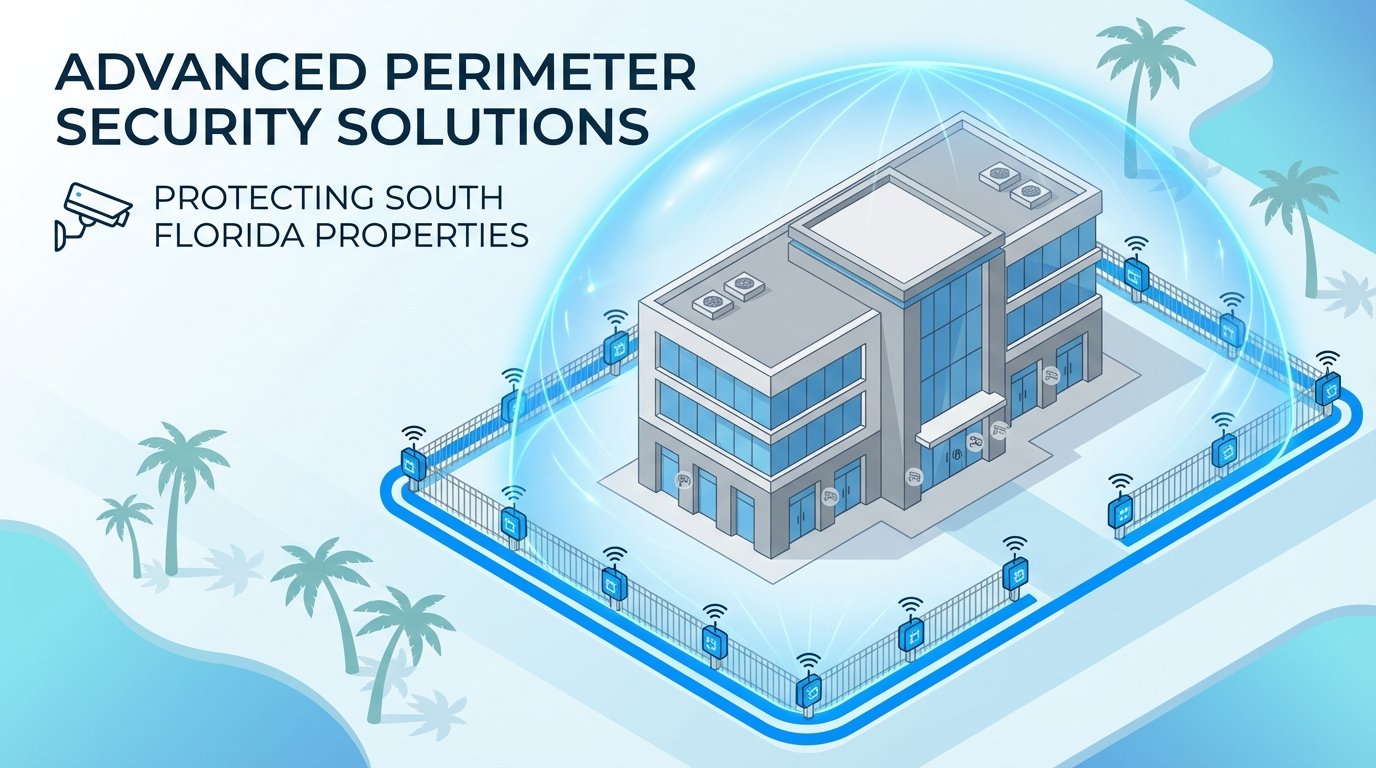
Perimeter intrusion detection systems function as an early warning network positioned along property boundaries. Unlike traditional security measures that protect building entry points, these systems monitor the entire perimeter—fences, walls, gates, and open areas—creating a protective envelope around your property.
Modern perimeter security protection systems integrate multiple detection technologies working together. Fence-mounted sensors detect vibrations, cuts, or climbing attempts. Buried cable sensors identify footsteps or vehicle movement along property lines. Microwave and infrared beams create invisible barriers that trigger alerts when broken. Advanced analytics software processes this information, distinguishing between genuine threats and false alarms from animals, weather, or debris.
The sophistication of these systems has evolved dramatically. Today’s solutions leverage artificial intelligence and machine learning to continuously improve detection accuracy, reducing false alarms while maintaining high sensitivity to actual intrusion attempts.
Components of Comprehensive Perimeter Security Systems
Detection Sensors and Technologies
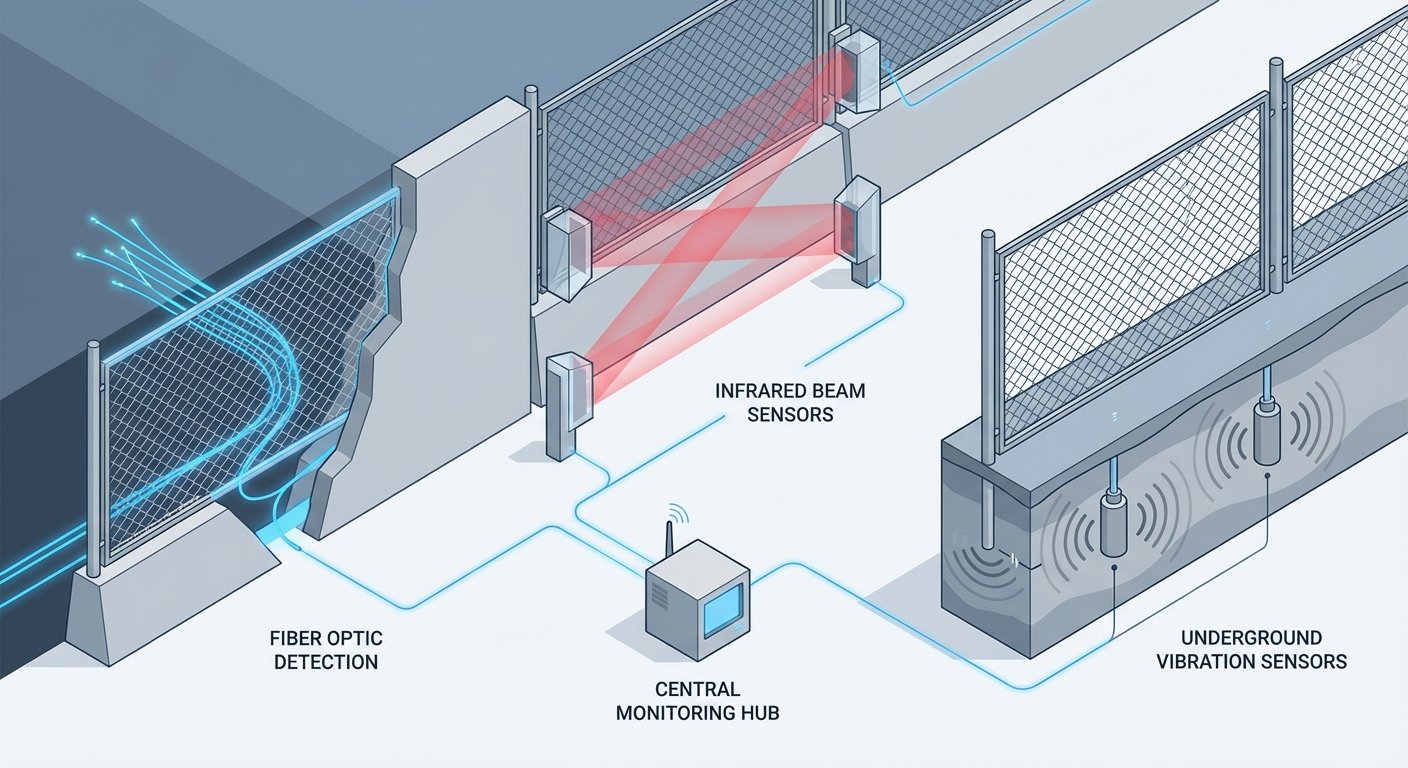
The foundation of any perimeter intrusion detection system lies in its sensing capabilities. Several technologies serve different applications and environments:
- Fiber Optic Sensors: Installed on or within fences, these detect disturbances through changes in light patterns, offering excellent sensitivity and immunity to electromagnetic interference common near South Florida’s coastal environments.
- Microwave Barriers: Creating invisible detection zones, these systems excel at protecting open areas, gaps between fences, or locations where physical barriers prove impractical.
- Seismic and Buried Cable Sensors: Installed underground along perimeter lines, these detect vibration patterns from walking, running, or vehicle movement while remaining completely invisible.
- Capacitance Sensors: Generating electrostatic fields around chain-link or wire fences, these detect changes when someone touches or approaches the barrier.
- Infrared Beam Detectors: Projecting multiple infrared beams across openings or along fence lines, these trigger when beams are interrupted.
Property Line Security Cameras
Visual verification separates legitimate alarms from false positives. Property line security cameras provide essential context when sensors detect activity, allowing security personnel to assess situations before dispatching response teams.
Strategic camera placement along perimeters creates overlapping coverage zones. Pan-tilt-zoom cameras monitor large areas and can automatically position themselves toward alarm locations. Fixed cameras provide constant monitoring of critical access points, gates, and vulnerable sections.
Integration between detection sensors and cameras enables powerful automated responses. When a fence sensor detects climbing activity, nearby cameras immediately zoom to that location, begin recording, and send live footage to monitoring stations. This coordinated response provides security teams with actionable intelligence within seconds.
Thermal Imaging Cameras Florida Applications
South Florida’s unique security challenges—including limited lighting along extensive perimeters, dense vegetation, and varying weather conditions—make thermal imaging cameras Florida essential components of advanced perimeter systems.
Unlike conventional cameras that require visible light, thermal imaging cameras detect heat signatures emitted by people, vehicles, and animals. This technology functions equally well in complete darkness, through light fog, and despite visual obstructions like bushes or tall grass that might hide intruders from traditional cameras.
For properties with large perimeters—distribution centers, industrial facilities, gated communities, or agricultural operations—thermal imaging cameras Florida solutions provide reliable detection across hundreds or thousands of feet. Advanced thermal cameras feature built-in analytics that automatically detect and track human-shaped heat signatures while filtering out animals and environmental factors.
The return on investment for thermal imaging becomes clear when considering the alternative: illuminating entire perimeters with traditional lighting creates significant energy costs, light pollution concerns, and still leaves gaps in coverage. Thermal technology eliminates these issues while often providing superior detection capabilities.
Perimeter Security for South Florida Property Types
Commercial and Industrial Facilities
Warehouses, manufacturing plants, distribution centers, and industrial yards face constant threats from theft, trespassing, and vandalism. Perimeter intrusion detection creates a security zone that detects threats when they’re still dozens or hundreds of feet from valuable inventory, equipment, or facilities.
For facilities storing high-value goods, early detection provides time to secure assets, activate additional security measures, and coordinate law enforcement response. The documented presence of perimeter security also serves as a powerful deterrent, often causing would-be intruders to abandon attempts before breaching the property.
Insurance providers increasingly recognize the value of comprehensive perimeter security protection systems. Many commercial property insurers offer premium reductions for facilities with professionally installed and monitored detection systems, creating ongoing cost savings that offset system investment.
Community Security Systems
Homeowners associations, gated communities, and residential developments implement community security systems to protect residents and common areas. Perimeter detection along community boundaries, combined with access control at gates, creates layered security that prevents unauthorized entry.
Modern community security systems balance protection with livability. Advanced analytics distinguish between residents, visitors, and potential threats. Integration with access control databases automatically identifies authorized individuals while flagging unknown persons. Community managers receive detailed reporting on perimeter events, enabling data-driven decisions about security staffing, lighting, and policy.
The collaborative nature of community security allows cost-sharing across multiple homeowners, making sophisticated perimeter intrusion detection systems economically feasible for residential applications where individual homeowners might find such systems prohibitively expensive.
Government and Critical Infrastructure
Government facilities, utilities, water treatment plants, and other critical infrastructure require the highest levels of perimeter security. These installations often face specific regulatory requirements mandating certain security measures and response capabilities.
Multi-layered detection creates redundancy—if one sensor type fails or is compromised, additional systems maintain security coverage. Government applications typically integrate perimeter detection with vehicle barriers, access control, visitor management, and command center monitoring to create comprehensive security ecosystems.
Design Considerations for South Florida Installations
Environmental Factors
South Florida’s climate presents specific challenges for perimeter security installations. High humidity, salt air in coastal areas, intense UV exposure, and seasonal storms require equipment rated for harsh outdoor environments. Professional-grade systems specify corrosion-resistant materials, weatherproof housings, and components designed for tropical climates.
Lightning protection becomes critical for perimeter systems covering large areas. Proper grounding, surge suppression, and equipment isolation prevent lightning strikes from destroying detection sensors, cameras, and control systems.
Seasonal heavy rains can create false alarms in improperly configured systems. Professional installation includes proper sensor calibration, drainage considerations, and analytics tuning to maintain detection accuracy during storms while filtering weather-related triggers.
Vegetation Management
Florida’s year-round growing season means vegetation can quickly interfere with detection zones. Trees growing near fence lines create moving shadows and swaying branches that trigger motion detection. Overgrown bushes might block camera views or create hiding spots.
System design should account for vegetation management requirements. Some detection technologies—particularly thermal imaging and certain sensor types—prove more resistant to vegetation interference than others. Site surveys identify problematic vegetation that requires regular trimming or removal to maintain system effectiveness.
Power and Communication Infrastructure
Perimeter systems extending hundreds or thousands of feet from main buildings require reliable power and network connectivity. Options include trenching electrical and network cables, using wireless communication links for remote sensors, or implementing solar-powered remote detection stations.
Backup power systems ensure continued operation during outages—a critical consideration in hurricane-prone South Florida. Battery backup, generator integration, or solar power with storage maintain perimeter security when conventional power fails.
Integration with Comprehensive Security Systems
Perimeter intrusion detection delivers maximum value when integrated with broader security infrastructure. Modern security platforms unify perimeter sensors, cameras, access control, intrusion alarms, and monitoring into cohesive systems.
When perimeter sensors detect activity at the fence line, integrated systems can automatically:
- Activate nearby cameras and begin recording
- Illuminate the affected area with remotely controlled lighting
- Send alerts to security personnel with live video feeds
- Lock down access control points to prevent entry
- Activate audio warnings through public address systems
- Create detailed event logs for investigation and reporting
This coordinated response transforms individual security components into force multipliers. Integration also centralizes management—security directors monitor and control all systems from unified platforms rather than juggling multiple separate interfaces.
Professional Installation and Monitoring
While perimeter security technology has advanced dramatically, proper implementation requires specialized expertise. Professional installation ensures optimal sensor placement, correct calibration, reliable power and communications, and integration with existing security infrastructure.
Site surveys identify vulnerable areas, optimal sensor locations, camera placement for complete coverage, and potential interference sources. Professional installers understand local building codes, security regulations, and best practices specific to South Florida environments.
Ongoing monitoring transforms detection into protection. Professional monitoring centers provide 24/7 oversight, responding to alarms, verifying threats, coordinating law enforcement response, and maintaining system health. Many property owners lack the resources to staff their own security operations centers—professional monitoring services provide enterprise-grade security oversight at predictable monthly costs.
Selecting the Right Perimeter Security Protection Systems
Choosing appropriate perimeter intrusion detection requires careful analysis of specific security needs, property characteristics, budget constraints, and operational requirements.
Start by assessing your property’s unique risk profile. What assets require protection? What threats are most likely—theft, vandalism, trespassing, or more serious security concerns? How quickly must security personnel respond to perimeter breaches? What consequences would result from successful intrusions?
Consider your property’s physical characteristics. Perimeter length directly impacts system costs. Terrain variations might require different detection technologies for different sections. Existing fencing, walls, or barriers influence sensor selection. Adjacent properties, public access areas, or environmental features affect system design.
Budget planning should encompass initial installation costs plus ongoing expenses for monitoring, maintenance, and system updates. While comprehensive perimeter security represents significant investment, costs should be weighed against potential losses from successful intrusions, insurance implications, liability concerns, and the value of deterrence.
Return on Investment and Risk Mitigation
Perimeter intrusion detection systems deliver measurable returns through theft prevention, reduced insurance premiums, improved incident response, and liability protection. A single prevented theft of high-value equipment or inventory often justifies years of system costs.
Beyond direct financial returns, perimeter security provides risk mitigation difficult to quantify but critically important. Early detection prevents situations from escalating. Video documentation protects against false liability claims. Visible security infrastructure deters most opportunistic criminals before attempts occur.
For businesses, security incidents create costs beyond stolen property—operational disruptions, employee concerns, customer confidence, and reputation damage compound direct losses. Comprehensive perimeter protection minimizes these cascading risks.
Frequently Asked Questions
How far can perimeter intrusion detection systems monitor?
Detection range varies by technology. Thermal imaging cameras can effectively monitor 1,000+ feet in optimal conditions. Fence-mounted sensors protect the specific fence section where installed. Microwave barriers typically span 300-600 feet per device. Professional system design combines multiple technologies to cover properties of any size.
Do perimeter systems generate many false alarms?
Modern systems with proper installation and calibration maintain very low false alarm rates. Advanced analytics filter environmental factors like animals, weather, and vegetation movement. Multi-technology verification—requiring two different sensor types to confirm alarms—virtually eliminates false positives while maintaining detection reliability.
Can existing fences and cameras integrate with new perimeter detection?
Most professional perimeter systems integrate with existing security infrastructure. Cameras, access control, and alarm systems typically connect through industry-standard protocols. Existing fences often accommodate retrofit sensors. Professional assessment determines integration feasibility and optimal approaches.
What maintenance do perimeter security systems require?
Regular maintenance includes sensor testing, camera cleaning and adjustment, vegetation management, software updates, and backup battery replacement. Professional maintenance agreements ensure systems remain fully operational with quarterly or semi-annual service visits plus emergency response when needed.
Protect Your Property with Professional Perimeter Security
Perimeter intrusion detection systems represent the first line of defense for South Florida properties facing security threats. By detecting and responding to boundary breaches before intruders reach buildings or assets, these systems provide time, information, and response capabilities that traditional security measures cannot match.
Whether protecting commercial facilities, residential communities, or critical infrastructure, professionally designed and installed perimeter security protection systems deliver measurable risk reduction and peace of mind. The integration of advanced sensors, property line security cameras, thermal imaging technology, and intelligent analytics creates comprehensive protection adapted to your specific security requirements.
TechPro Security Products specializes in designing, installing, and maintaining sophisticated perimeter intrusion detection systems for South Florida commercial properties, HOAs, and government facilities. Our experienced team conducts thorough site assessments, recommends optimal technology combinations, and implements integrated solutions that protect your property 24/7. Contact us today to schedule a comprehensive security evaluation and discover how professional perimeter protection can safeguard your South Florida property.
{ “@context”: “https://schema.org”, “@type”: “FAQPage”, “mainEntity”: [ { “@type”: “Question”, “name”: “How far can perimeter intrusion detection systems monitor?”, “acceptedAnswer”: { “@type”: “Answer”, “text”: “Detection range varies by technology. Thermal imaging cameras can effectively monitor 1,000+ feet in optimal conditions. Fence-mounted sensors protect the specific fence section where installed. Microwave barriers typically span 300-600 feet per device. Professional system design combines multiple technologies to cover properties of any size.” } }, { “@type”: “Question”, “name”: “Do perimeter systems generate many false alarms?”, “acceptedAnswer”: { “@type”: “Answer”, “text”: “Modern systems with proper installation and calibration maintain very low false alarm rates. Advanced analytics filter environmental factors like animals, weather, and vegetation movement. Multi-technology verification—requiring two different sensor types to confirm alarms—virtually eliminates false positives while maintaining detection reliability.” } }, { “@type”: “Question”, “name”: “Can existing fences and cameras integrate with new perimeter detection?”, “acceptedAnswer”: { “@type”: “Answer”, “text”: “Most professional perimeter systems integrate with existing security infrastructure. Cameras, access control, and alarm systems typically connect through industry-standard protocols. Existing fences often accommodate retrofit sensors. Professional assessment determines integration feasibility and optimal approaches.” } }, { “@type”: “Question”, “name”: “What maintenance do perimeter security systems require?”, “acceptedAnswer”: { “@type”: “Answer”, “text”: “Regular maintenance includes sensor testing, camera cleaning and adjustment, vegetation management, software updates, and backup battery replacement. Professional maintenance agreements ensure systems remain fully operational with quarterly or semi-annual service visits plus emergency response when needed.” } } ] }