

Unlimited Storage Free: The 2025 Myth & Catch
Why Digital Space Matters More Than Ever
Unlimited storage free options promise to solve a modern problem: our endless need for digital space. But before you start uploading your entire life to the cloud, here’s what you need to know:
| Quick Facts About Free Storage |
|---|
| Truly Unlimited? No major provider offers genuinely unlimited free storage |
| Largest Free Tier: Some offer up to 1TB free (with ads and limitations) |
| Typical Free Storage: Most providers offer 5-15GB free |
| Common Catches: Ads, speed limits, file size caps, reduced security features |
| Best Free Options: Generous plans offer 20GB+ or grow with referrals |
Your phone just buzzed with that dreaded notification: “Storage Almost Full.” You’ve got thousands of photos, security camera footage, important documents, and videos you can’t bear to delete. The promise of unlimited storage free sounds like the perfect solution—a digital attic where you can stash everything without worry or cost.
But here’s the reality: truly unlimited free cloud storage doesn’t exist. What does exist are generous free tiers, clever business models, and strategic limitations designed to eventually convert you into a paying customer. Some services offer substantial free storage, while others use referral programs to expand your space. The key is understanding what you’re actually getting—and what you’re giving up in return.
The trade-offs are real. Free storage often means slower speeds, advertisements, limited features, and potential privacy concerns. Some services scan your files for advertising purposes. Others may shut down unexpectedly, taking your data with them. As one industry expert noted, even paid services face challenges—physical drives have a notable annual failure rate, which is why cloud storage became popular in the first place.
For home security, the stakes are even higher. That doorbell camera footage or security system backup isn’t just data—it’s evidence that could protect your family and property. Storing it on a questionable free service with weak encryption or unreliable uptime isn’t worth the risk.
I’m Brad Besner, founder of TechPro Security Products, and over my 15+ years in the security industry, I’ve seen countless homeowners struggle with balancing storage needs and security requirements—including the appeal of unlimited storage free solutions that often compromise data protection. Understanding these trade-offs is essential for making informed decisions about where you store your most important digital assets.
The Myth of “Truly” Unlimited Storage Free: What’s the Catch?
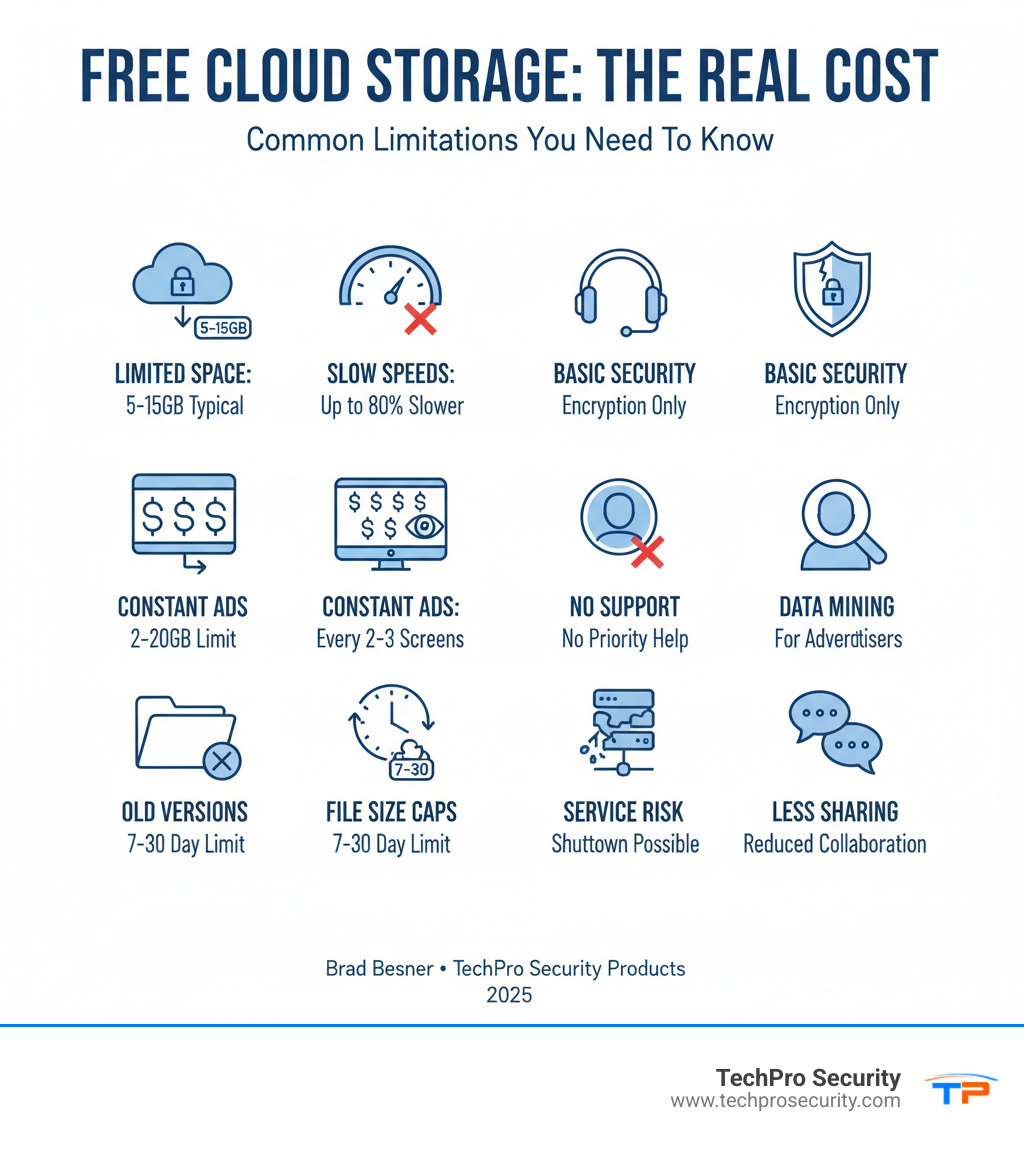
Unlimited storage free sounds too good to be true because it usually is. When a service promises unlimited free storage, there’s always a catch. No company can afford to give away endless server space and bandwidth without getting something in return. The question isn’t whether there’s a catch—it’s what that catch is and whether you can live with it.
The business model behind free cloud storage is to attract millions of users with a free tier, then convert a small percentage into paying customers who subsidize the service for everyone else. To encourage upgrades, providers build in limitations that become more apparent as you use the service more.
The hidden costs aren’t always financial. Many free services support themselves through advertising, which can involve analyzing your files to serve targeted ads. Your personal files might be scanned by algorithms looking for keywords. Some providers are transparent about this, while others bury it in their terms of service.
Reliability is another concern. Free services often have minimal customer support. If your account is locked or files disappear, you may have no one to help. I’ve spoken with homeowners who lost irreplaceable security footage because their free provider shut down with little notice.
Speed is a common pressure point. Free users often get significantly slower upload and download speeds. For small files, this might not matter. But try uploading hundreds of gigabytes of security footage at throttled speeds, and you’ll quickly understand the limitation.
Typical Limitations of Free Plans

When you dig into what unlimited storage free actually means, you’ll find a consistent pattern of restrictions designed to push you toward paid plans.
- Speed Throttling: Your uploads and downloads crawl at a fraction of the speed paid users enjoy. An hour-long upload might take five hours on a free plan.
- File Size Caps: You might have 1TB of free storage, but if you can’t upload any single file larger than 2GB, that space is less useful for large files like 4K video or system backups.
- Limited File Versioning: The ability to recover previous versions of files is often severely limited or absent. Most free plans offer only 7-30 days of version history, if any.
- Basic Security: You’ll get standard encryption, but advanced protections like end-to-end encryption are typically reserved for paid tiers.
- Stripped-Down Features: Collaboration tools, advanced sharing options, and data transfer limits are common restrictions on free accounts.
Potential Risks and Drawbacks
Beyond limitations, free storage comes with risks, especially for South Florida homeowners storing security footage or important documents.
- Data Mining: When a service is free, your data can become the product. Providers may scan your files and track usage to build advertising profiles.
- Service Termination: Free services can disappear with little notice. If you haven’t maintained other backups, your data could be gone forever.
- Security Vulnerabilities: To keep costs down, free services might not invest as heavily in cutting-edge security, making your data a more attractive target for hackers.
- Minimal Recovery Options: If your account is suspended or files are corrupted, free users usually have nowhere to turn. Paid customers get priority support and recovery tools.
Transparency matters tremendously. A provider that clearly explains its business model, data policies, and security measures is more trustworthy than one hiding behind vague language. At TechPro Security, we believe transparency is fundamental to building trust with the people we protect.
Finding Your Digital Attic: Types of Generous Free Storage Plans
While genuinely unlimited storage free remains a myth, several providers offer surprisingly generous free tiers. The trick is understanding that there’s no single “best” option—what works for your photos might fall short for your security footage. Think of these offers as differently sized gift boxes; each has its purpose.

The “Mega-GB” Welcome Bonus
Some providers hook you with massive amounts of storage—we’re talking 100GB to 1TB right from signup. If you need to dump a huge archive of family photos or old project files, these services are appealing. The catch? You’ll likely see advertisements, and upload speeds may be slow. But if you’re archiving non-sensitive files you don’t need to access constantly, it’s hard to beat the sheer volume. These services bet that once you’ve filled their free space, you’ll pay rather than move everything elsewhere.
The “Earn Your Space” Model
What if your storage could grow as you bring friends along? That’s the idea behind the “earn your space” approach. These services start you with modest storage but reward you for spreading the word. Some give you a generous starting amount (e.g., 40GB) and then add more for each successful referral, potentially letting you earn up to 400GB of unlimited storage free. This model works beautifully if you have a large network, turning storage expansion into a social activity.
The “Feature-Limited” Ecosystem Tier
The big technology companies typically offer smaller free tiers—usually 5-15GB—but they compensate with reliability, security, and seamless integration with other tools you already use. If you’re already living in a specific tech ecosystem, this integration is effortless. Your documents, spreadsheets, and photos sync automatically across devices. These tiers are designed for document syncing and light storage rather than massive archives, betting you’ll value the convenience enough to eventually upgrade.
The Niche “Unlimited” Offer
Sometimes “unlimited” doesn’t mean unlimited everything—it means unlimited something specific. These specialized offers can be incredibly valuable if your needs align. For example, some services offer unlimited video uploads for free users. For anyone with home security cameras or family videos, this is a game-changer. The key is to check the fine print for caveats like resolution limits or format restrictions. Matching your primary storage need to the right niche offer can be a powerful strategy.
At TechPro Security, we understand that different types of data deserve different storage strategies—just like different parts of your home need different security solutions. The right plan is about matching your needs with the right service and understanding exactly what you’re getting.
Key Security Features to Demand from Any Cloud Storage
When evaluating any cloud storage solution—especially tempting unlimited storage free offers—security must be a top priority. At TechPro Security, we’ve spent over 15 years helping South Florida families protect what matters most. That same philosophy applies to your digital life. Just because something is free doesn’t mean it should leave your data vulnerable.
Think of it this way: you wouldn’t leave your front door open uped for convenience. The same logic applies to your cloud storage. Your family photos, home security footage, and important documents deserve protection, whether you’re paying for storage or not.
End-to-End & Zero-Knowledge Encryption
Understanding these two terms could save your data from prying eyes.
End-to-End Encryption (E2EE) is like sending a locked box that only you and the recipient have keys to open. Your files are encrypted on your device before they go to the cloud and stay encrypted until they’re downloaded again. No one in between—not even the cloud provider—can peek inside.
Zero-Knowledge Encryption takes this further. With zero-knowledge systems, the provider literally can’t look at your data. They don’t have your encryption keys, so they can’t decrypt your files, read file names, or see any metadata. This matters for sensitive information. Even if the provider gets a legal request for your data or suffers a breach, your files remain secure because the provider has no way to access them.
Essential Account Protection
Encryption protects your files, but you also need to protect your account. The strongest encryption won’t help if someone steals your password.
Two-Factor Authentication (2FA) should be non-negotiable. This requires a second form of verification, like a code sent to your phone, before granting access. It’s one of the simplest and most effective security measures.
Also, look for remote device management. If a device is lost or stolen, you need the ability to remotely disconnect it from your cloud storage. Secure password practices are also critical—use strong, unique passwords for each service. Finally, activity monitoring can alert you to suspicious login attempts, giving you an early warning if something is wrong.
Secure File Sharing and Privacy
Sharing files is a primary use for cloud storage, but it must be done securely.
- Password-protected sharing links add a layer of protection beyond just having the link.
- Link expiry dates give you control by automatically revoking access after a set time.
- Revocable access is your safety net, allowing you to instantly cut off access to a shared link at any time.
Data jurisdiction and privacy laws also impact your privacy. Where your data is physically stored determines which country’s laws apply. For instance, data stored in Switzerland is protected by some of the world’s strongest privacy laws. Always read the terms of service to understand what the provider can do with your data and how they handle government requests.
Maximizing Benefits and Minimizing Risks
Unlimited storage free services are useful when used strategically, but they aren’t a magic solution. Think of them as extra garage spaceperfect for seasonal items, but not for your jewelry collection. The key is understanding where free storage fits into your overall data protection strategy. It’s about building layers of security, not putting all your eggs in one free basket.
Best Use Cases for unlimited storage free
Free cloud storage shines in several scenarios where the trade-offs make sense.
- Personal photo and video backups are a great use case. For everyday memories that aren’t highly sensitive, generous free services are perfect.
- Archiving large project files is another smart application. For completed projects with massive media files you want to keep but don’t need to access often, free storage is ideal.
- Sharing non-sensitive documents with friends and family is convenient when email attachments are too small.
- Temporary storage for file transfers is a practical use. Upload a large file, send the link, and delete it once it’s been downloaded.
What NOT to Store on free unlimited storage
Unless a free service explicitly offers zero-knowledge, end-to-end encryption, certain files should never touch their servers.
- Sensitive personal data like Social Security numbers, scanned passports, and medical records are identity theft gold mines.
- Financial records such as bank statements, tax documents, and credit card information belong on paid services with robust security or encrypted local storage.
- Business-critical information like client data, trade secrets, and legal contracts shouldn’t be entrusted to a service that might disappear or scan your files.
The bottom line: if losing a file or having it exposed would cause serious harm, don’t store it on a free service without exceptional security guarantees.
The 3-2-1 Backup Strategy
Even with the best cloud storage, relying on a single backup is risky. Security professionals swear by the 3-2-1 backup strategy, which we strongly recommend to all our clients at TechPro Security.
Here’s how it works: maintain three copies of your data on two different media types, with one copy offsite. For background on this approach, see the 3-2-1 backup rule.
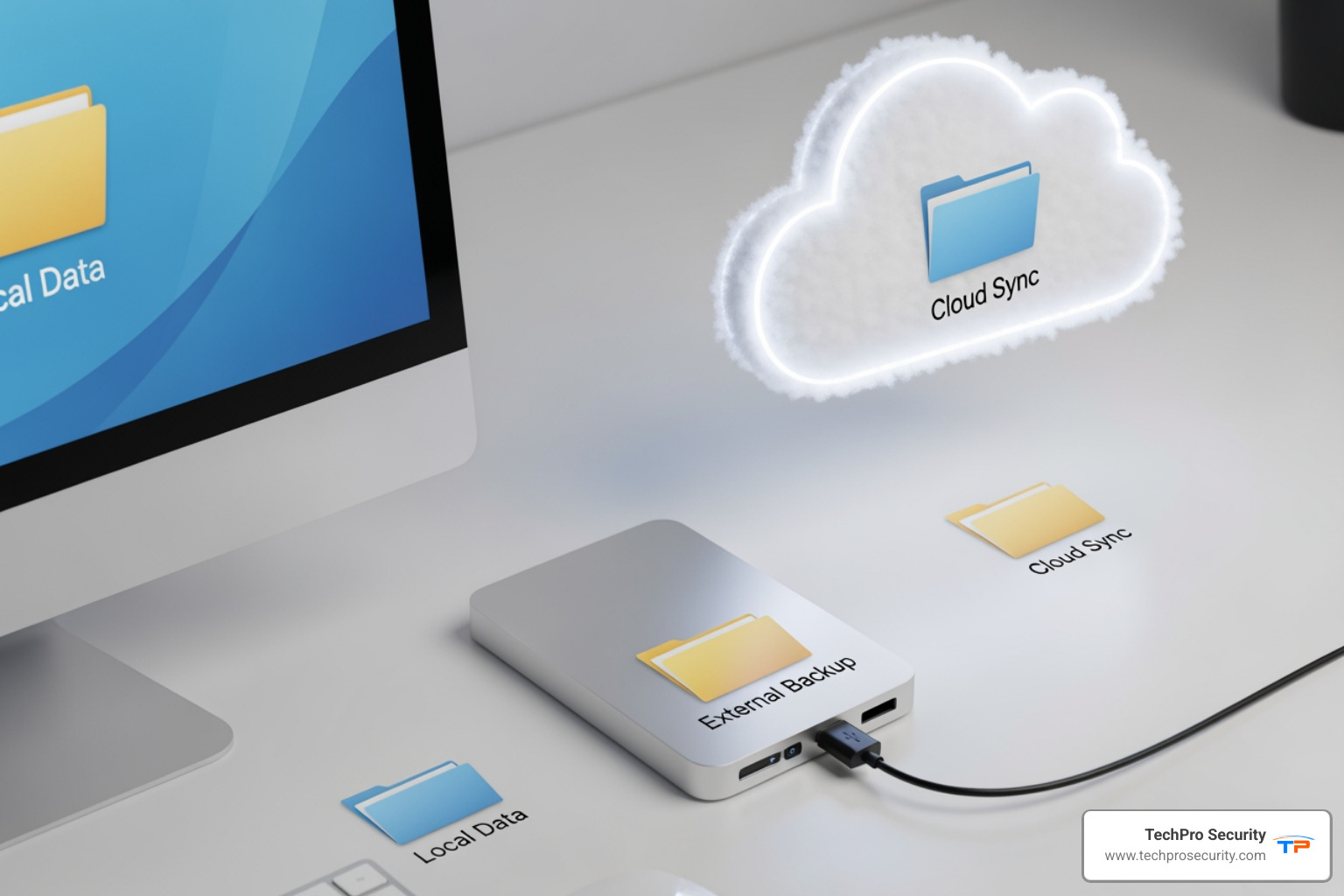
This is where unlimited storage free options can prove their value. They’re perfect for that offsite copy, protecting your data from local disasters like fires, floods, or theft. Living in South Florida, we understand this better than most. Hurricane season is an annual reality that can wipe out physical storage in hours.
Why bother? Because all storage devices eventually fail. An external backup drive on your desk won’t help if your house floods. Cloud storageeven free cloud storagesolves that problem by putting a copy of your data somewhere completely separate. The 3-2-1 strategy isn’t paranoia; it’s practical protection.
Frequently Asked Questions about Free Cloud Storage
We get a lot of questions about cloud storage, especially when the word “free” is involved. After helping countless South Florida homeowners and businesses, I’ve heard just about every question. Let’s clear up some common misconceptions.
Is 1TB of free storage really free?
Yes, but you pay in non-monetary ways. A provider offering 1TB of unlimited storage free won’t send you a bill, but you should expect trade-offs. These often include advertisements, noticeably slower upload and download speeds, and fewer advanced features compared to paid tiers. Some free services may also analyze your data to serve targeted ads. For non-sensitive files, this trade-off might be acceptable. For anything important, consider if the “free” price is worth the compromises in convenience and privacy.
Can I lose my files on a free cloud storage service?
Absolutely. Data loss is a real risk. Files can disappear for several reasons: service shutdowns with little warning, accidental deletion with short recovery windows, or account suspension for unintentional terms of service violations. While less common, data breaches can also affect any cloud service, and free providers may invest less in security infrastructure. This is why the 3-2-1 backup strategy is so critical. Never trust your important files to a single location, especially a free one.
How is free storage different from paid storage?
The differences are substantial. Paid plans offer more storage capacity, faster performance without speed throttling, and advanced security features like end-to-end encryption and ransomware protection. Another key difference is support. Paid users get priority customer support from real people, while free users often rely on community forums. Paid plans also provide better collaboration tools and service level agreements (SLAs) that guarantee uptime, which is essential for business continuity. For critical data, these benefits are often worth the investment.
Conclusion
The search for unlimited storage free is understandable. Between family photos, work documents, and security camera recordings, we’re all managing a flood of digital files. The promise of endless free space sounds like the perfect solution.
However, truly unlimited storage free doesn’t exist as we imagine it. Instead, you’ll find generous free tiers and clever programs, each with its own catches like ads, slow speeds, or privacy trade-offs. The key is making informed choices. A 1TB free offer might be perfect for vacation photos, but it’s the wrong place for financial records. Smart usage means understanding what you’re getting—and what you’re giving up.
For those of us in South Florida, from Aventura to West Palm Beach, protecting digital assets is as important as securing physical property. At TechPro Security, we’ve spent over 15 years creating comprehensive security solutions. While we specialize in cameras and access control, we know true peace of mind comes from protecting both your physical and digital worlds.
Our approach is straightforward: experienced teams, extensive warranties, and free US-based support. We believe security should simply work. The smartest strategy is to use free cloud storage thoughtfully. Use it for personal photos, project archives, or sharing files with friends. But for anything irreplaceable, invest in proper security. Remember the 3-2-1 backup rule: three copies, two storage types, one offsite. Free cloud storage can be that offsite backup, but it shouldn’t be your only safety net.
By understanding the limits of free storage and using it correctly, you can build a secure digital foundation that protects what matters most.
Learn more about secure cloud backup and file storage solutions