
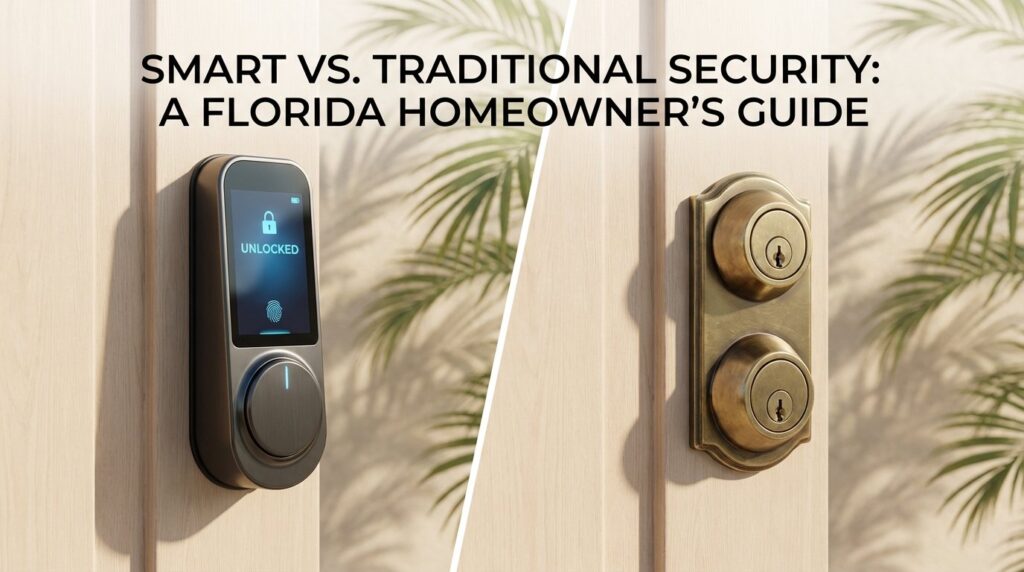
Smart Locks vs Traditional Locks: The Complete 2026 South Florida Security Guide
After fifteen years of installing and servicing security systems across South Florida, I’ve witnessed the lock industry transform dramatically. What started as basic mechanical deadbolts has evolved into sophisticated smart locking systems that integrate seamlessly with comprehensive security platforms. The question I hear most often from property owners and managers isn’t whether smart locks work—it’s whether they’re the right choice for Florida’s unique challenges.
The debate between smart locks vs traditional locks isn’t simply about old versus new technology. It’s about understanding which security solution aligns with your specific needs, environmental conditions, and operational requirements. In 2026, both options offer distinct advantages, and making the wrong choice can compromise security or waste thousands in replacement costs.
This guide draws from real installations across commercial properties, HOAs, and enterprise facilities throughout South Florida. I’ll walk you through everything you need to know to make an informed decision that protects your property for years to come.
Understanding the Fundamental Difference Between Smart and Traditional Locks

Traditional locks operate on a purely mechanical principle that’s remained largely unchanged for over a century. A metal key aligns pins within a cylinder, allowing the bolt to retract. There’s no power source, no connectivity, and no electronic components to fail.
Smart locks, conversely, use electronic mechanisms controlled by various authentication methods—keypads, smartphones, biometric scanners, or key fobs. They require power (typically batteries or hardwired connections) and often integrate with broader security systems, providing access logs, remote control, and automated responses to security events.
The critical distinction goes beyond the mechanics. Traditional locks provide static security—they’re either locked or unlocked, with no record of who accessed them or when. Smart locks offer dynamic security with full audit trails, temporary access capabilities, and integration with other security components like cameras and alarm systems.
How Florida’s Climate Changes the Equation
Here in South Florida, we face security challenges that property owners in Arizona or Colorado simply don’t encounter. Salt air from the ocean corrodes metal components. Humidity levels exceeding 80% can wreak havoc on electronics. Hurricane-force winds create physical stresses that can damage improperly installed locking mechanisms.
I’ve replaced dozens of consumer-grade smart locks that failed within months because they weren’t engineered for Florida’s coastal environment. Traditional locks also suffer—I’ve seen mechanical cylinders seized by corrosion and keys that won’t turn because salt deposits have accumulated inside the mechanism.
The solution isn’t choosing one over the other based solely on technology type. It’s selecting products specifically rated for marine and high-humidity environments, then ensuring proper installation that accounts for Florida’s unique conditions.
10 Critical Factors in the Smart Locks vs Traditional Locks Comparison

1. Security Level and Vulnerability Assessment
Traditional locks face well-documented vulnerabilities. Lock picking, bumping, and drilling are proven attack methods. However, a high-quality traditional deadbolt with anti-pick pins and drill-resistant plates provides substantial security against forced entry.
Smart locks introduce different security considerations. While they eliminate traditional picking vulnerabilities, they potentially expose properties to digital attacks like relay hacking or Bluetooth signal interception. In my experience with commercial installations, properly configured enterprise-grade smart locks with encrypted communication protocols offer superior security to traditional locks.
The key difference: traditional locks are defeated through physical skill or brute force, while smart locks require technical knowledge to breach digitally. Most criminals lack this sophistication, making both options secure when properly implemented.
2. Access Control and Management Capabilities
This is where smart locks demonstrate clear advantages for commercial properties and HOAs. Recently, we installed a smart access system for a Boca Raton business park with 47 units. The property manager can now grant temporary access to vendors, track entry times for all tenants, and immediately revoke access when leases terminate—all from a smartphone.
Traditional locks require physical key management. Lost keys necessitate rekeying, terminated employees might retain access, and tracking who entered when becomes impossible without additional security measures.
For facilities requiring multiple access levels—like maintenance accessing common areas but not individual units—smart locks provide granular control that traditional systems can’t match without complex master keying arrangements.
3. Environmental Durability in Coastal Conditions
Not all locks withstand Florida’s corrosive coastal environment equally. I’ve tested dozens of products across various South Florida installations, and the results are telling.
Quality traditional locks made from marine-grade materials (solid brass or stainless steel with proper coatings) can last decades in coastal environments. They require periodic lubrication with graphite or PTFE-based products—never oil-based lubricants that attract salt and moisture.
Smart locks need additional protection. We specify models with BHMA Grade 1 ratings and IP65 or higher weather resistance. The electronics require conformal coating to prevent moisture intrusion, and battery compartments need proper sealing. Installation location matters significantly—locks under covered entries last considerably longer than those exposed to direct rain and salt spray.
4. Hurricane Preparedness and Storm Resilience
Hurricane season brings unique security challenges. During evacuations, properties sit unattended for days or weeks. Power outages can last longer. Wind-driven rain finds its way into places that normally stay dry.
Traditional locks maintain full functionality regardless of power availability. They don’t require battery changes at inconvenient times, and they’re unaffected by power surges or electrical failures.
Smart locks need backup power considerations. We always install models with mechanical key overrides and specify high-capacity lithium batteries that maintain charge through extended power outages. For critical access points, we integrate smart locks with backup power systems as part of comprehensive security infrastructure planning.
After Hurricane Nicole in 2022, several properties with smart locks experienced access issues because batteries died during extended power outages. Since then, we’ve implemented quarterly battery replacement schedules and mechanical override verification as part of our maintenance programs.
5. Integration with Comprehensive Security Systems
Modern security isn’t about isolated components—it’s about integrated systems where access control, video surveillance, and intrusion detection work together. This is where smart locks truly excel.
When integrated properly, smart locks communicate with video systems to capture footage whenever doors are accessed. They can trigger alarm responses if forced entry is attempted and coordinate with automated security systems to implement comprehensive protection protocols.
For example, we recently implemented a system for a Miami office building where smart locks automatically engage when the intrusion detection system arms. If someone attempts unauthorized access, the system immediately notifies security personnel, captures video evidence, and logs the event—all without human intervention.
Traditional locks require separate components for these capabilities, increasing installation complexity and ongoing maintenance requirements.
6. Maintenance Requirements and Long-Term Costs
Traditional locks require minimal maintenance—periodic lubrication and occasional adjustment. Replacement typically becomes necessary due to wear after thousands of cycles or physical damage. Quality commercial-grade traditional locks often last 15-20 years with proper maintenance.
Smart locks have additional maintenance considerations. Batteries require replacement every 6-12 months depending on usage frequency. Firmware updates need periodic installation to maintain security and functionality. Electronic components eventually fail, typically necessitating replacement after 7-10 years.
However, the operational efficiencies of smart locks often offset these costs. Eliminating physical key replacement, reducing locksmith calls for access changes, and preventing security breaches from lost keys can save commercial properties thousands annually.
7. Installation Complexity and Professional Requirements
Traditional deadbolt installation is straightforward for experienced installers but requires precision for proper security function. Improper installation leaves gaps that compromise security regardless of lock quality.
Smart lock installation adds complexity. Beyond mechanical installation, there’s electrical consideration, network configuration, and system integration. We’ve corrected numerous failed DIY smart lock installations where improper setup left properties vulnerable or made systems unreliable.
For commercial properties, professional installation isn’t optional—it’s essential for warranty compliance, insurance requirements, and ensuring systems function correctly under Florida’s environmental conditions.
8. User Experience and Convenience Factors
Traditional locks require physical keys, which people lose, forget, or need duplicated. However, they’re universally understood—everyone knows how to use a key.
Smart locks eliminate key management frustrations. Residents use codes, smartphones, or biometric authentication. Temporary access for guests, vendors, or service providers takes seconds to configure and automatically expires.
For properties with high turnover—vacation rentals, short-term commercial leases, or facilities with frequent contractor access—smart locks dramatically improve operational efficiency. A Fort Lauderdale HOA we work with eliminated their entire physical key management system, saving over $5,000 annually in rekeying costs alone.
9. Compliance and Insurance Considerations
Insurance companies increasingly recognize the security advantages of properly implemented smart access systems. Some insurers offer premium reductions for commercial properties with monitored electronic access control, comprehensive audit trails, and integrated security systems.
However, specifications matter. Many insurance policies require BHMA Grade 1 locks for commercial applications, and both traditional and smart options can meet this standard. For government facilities or properties handling sensitive information, specific access control standards may mandate electronic systems with audit capabilities that traditional locks cannot provide.
Before making significant lock system investments, property owners should consult with insurance carriers about requirements and potential premium impacts.
10. Cybersecurity and Digital Vulnerability
This concern comes up in virtually every commercial security consultation. Property managers worry about hackers remotely unlocking doors or accessing systems through compromised networks.
The reality: properly configured enterprise-grade smart locks with encrypted communication, regular firmware updates, and network segmentation provide excellent security against digital attacks. Consumer-grade systems with weak default passwords and outdated firmware present genuine vulnerabilities.
We implement smart lock systems on dedicated security VLANs, separate from general business networks. Access credentials use multi-factor authentication, and we maintain firmware updates as part of ongoing service agreements. These precautions effectively mitigate digital security risks.
Traditional locks, being entirely mechanical, have zero digital vulnerability—but they also lack audit trails that can identify security breaches after they occur.
Advantages and Disadvantages: The Comprehensive Breakdown
Traditional Locks: Pros and Cons
Advantages:
- No power requirements—function during extended outages
- Proven reliability with decades of field performance
- Lower upfront costs for basic security needs
- No digital vulnerabilities or cybersecurity concerns
- Minimal maintenance requirements beyond periodic lubrication
- Universal understanding—no user training required
- Excellent longevity with quality materials (15-20+ years)
Disadvantages:
- No access tracking or audit trail capabilities
- Physical key management creates operational complexity
- Vulnerable to picking, bumping, and other mechanical attacks
- Access changes require physical rekeying or lock replacement
- Cannot integrate with automated security systems
- No remote access or control capabilities
- Lost keys create security vulnerabilities until rekeying occurs
Smart Locks: Pros and Cons
Advantages:
- Comprehensive audit trails document all access events
- Remote access management and monitoring capabilities
- Temporary access creation without physical key duplication
- Integration with video surveillance and alarm systems
- Immediate access revocation without physical changes
- Automated responses to security events
- Elimination of physical key management costs and complications
- Multiple authentication methods for different user types
Disadvantages:
- Requires power source (batteries or hardwired)
- Higher upfront costs for quality commercial-grade systems
- Potential digital vulnerabilities if improperly configured
- More complex installation requiring professional expertise
- Additional maintenance requirements (batteries, firmware updates)
- Environmental sensitivity requiring marine-grade components for coastal areas
- User training needed for some authentication methods
Which Lock Type Should You Choose? Recommendations by Application
Commercial Properties and Office Buildings
For commercial applications, smart locks provide clear advantages that justify higher initial investments. The ability to grant and revoke access instantly, maintain detailed audit trails for compliance, and integrate with comprehensive security systems makes smart locks the preferred choice for most business environments.
We recommend smart lock systems for commercial properties that require:
- Access control for multiple tenants or user groups
- Audit trail documentation for compliance or security purposes
- Integration with existing video surveillance or alarm systems
- Frequent access changes due to employee or tenant turnover
- Remote management capabilities for off-site property managers
Traditional locks remain appropriate for commercial applications where audit trails aren’t required, budgets are extremely limited, or locations have unreliable power infrastructure that complicates smart lock implementation.
Homeowners Associations and Multi-Family Properties
HOAs represent an ideal application for smart lock technology. Common area access, amenity scheduling, and resident turnover create management challenges that smart systems solve efficiently.
A Delray Beach HOA we work with implemented smart locks on their fitness center, pool gates, and storage areas. Residents access facilities with their smartphones, the system prevents access outside permitted hours, and the board eliminated key deposit requirements. Access automatically revokes when residents sell or when renters’ leases terminate.
For individual residential units within HOA communities, the decision depends on personal preference and budget. Many residents appreciate the convenience of keyless entry, while others prefer traditional lock simplicity.
Government and Institutional Facilities
Government facilities typically require smart access systems due to compliance mandates, audit requirements, and security protocols. The ability to track access, implement role-based permissions, and integrate with comprehensive security infrastructure makes smart locks essentially mandatory for most institutional applications.
We’ve implemented systems for municipal facilities throughout South Florida where access logs integrate with security monitoring systems, providing comprehensive documentation that satisfies compliance requirements and supports investigations when security incidents occur.
Industrial and Warehouse Environments
Industrial applications demand extremely durable hardware capable of withstanding harsh environments and heavy use. Both traditional and smart options can meet these requirements with proper specification.
For facilities requiring controlled access to hazardous materials, valuable inventory, or sensitive areas, smart locks with detailed audit trails provide security and compliance documentation that traditional locks cannot offer.
In environments where power reliability is questionable or electromagnetic interference is prevalent, traditional locks may provide more reliable operation despite reduced access control capabilities.
The Florida-Specific Smart Lock Selection Criteria
Not every smart lock survives South Florida’s environment. After testing numerous systems across coastal installations, I’ve identified essential specifications for reliable performance:
Weather Resistance Requirements: Minimum IP65 rating for weather-exposed installations, with preference for IP67 in direct-exposure locations. Conformal coating on circuit boards prevents moisture intrusion that causes premature failure.
Material Specifications: Marine-grade stainless steel or solid brass construction with appropriate protective coatings. Avoid zinc alloy components in coastal applications—they corrode rapidly in salt air environments.
Battery Considerations: Lithium batteries significantly outperform alkaline options in high-humidity environments. We specify systems with low-battery warnings that provide at least 30 days’ notice before failure.
Mechanical Override: Every smart lock should include a mechanical key override for power failures or electronic malfunctions. Systems without this capability leave properties vulnerable during emergencies.
Installation Protection: Proper installation includes weatherproofing measures—silicone sealing around mounting points, protective covers for exposed electronics, and careful attention to drainage paths that prevent water accumulation.
These specifications significantly impact product selection and cost, but they’re non-negotiable for reliable long-term performance in Florida’s coastal climate.
Real-World Performance: Case Studies from South Florida Installations
Case Study: Coral Gables Office Complex
A 12-building office complex in Coral Gables was experiencing significant security challenges with traditional locks. Tenant turnover required frequent rekeying, former employees occasionally accessed buildings after termination, and the property management team couldn’t determine who accessed spaces when incidents occurred.
We implemented a comprehensive smart lock system across all entry points, integrated with existing video surveillance. Results after 18 months:
- Rekeying costs eliminated, saving approximately $8,000 annually
- Three attempted unauthorized entries detected and prevented through real-time alerts
- Property management efficiency improved with remote access management
- Insurance premium reduced by 7% due to enhanced security documentation
- Zero weather-related failures despite installation during 2025 hurricane season
Case Study: Pompano Beach HOA
A 240-unit HOA was managing nine common area facilities with traditional locks and physical key distribution. Lost keys, unauthorized key duplication, and inability to track facility usage created ongoing management problems.
Smart lock implementation on all common areas provided immediate improvements. Residents accessed facilities through a smartphone app with automatically scheduled permissions. The board implemented usage limits during high-demand periods, resolved disputes about who accessed facilities when, and eliminated security deposits for facility keys.
Eighteen months post-installation, the system operates with 99.6% uptime despite coastal exposure. Quarterly battery replacement prevents unexpected failures, and the HOA has saved over $12,000 in key management and lock replacement costs.
Integration with Comprehensive Security Infrastructure
Smart locks reach their full potential when integrated with broader security systems. Standalone smart locks provide access control benefits, but integrated systems deliver comprehensive security that responds intelligently to threats.
Our enterprise security implementations coordinate smart locks with video analytics, intrusion detection, and monitoring services. When someone attempts forced entry, the system immediately captures video, alerts security personnel, and logs detailed information about the incident—providing both real-time response and forensic documentation.
Advanced integrations include coordination with perimeter security systems that detect threats before they reach entry points. Smart locks automatically engage additional security protocols when perimeter sensors detect suspicious activity, creating layered defense that traditional locks cannot provide.
For properties considering AI-powered security cameras, integration with smart access control creates comprehensive security that learns normal patterns and identifies anomalies automatically.
Making the Right Choice for Your Property in 2026
The smart locks vs traditional locks decision isn’t about which technology is superior—it’s about which solution aligns with your specific security requirements, operational needs, and budget constraints.
Choose traditional locks when:
- Budget constraints limit initial investment in security infrastructure
- Access control requirements are simple with minimal user changes
- Audit trails and remote management aren’t necessary
- Power availability is unreliable or infrastructure doesn’t support electronic systems
- Environmental conditions are extremely harsh beyond smart lock specifications
Choose smart locks when:
- Property requires audit trails for compliance or security documentation
- Frequent access changes create operational complexity with traditional keys
- Integration with comprehensive security systems provides strategic benefits
- Multiple access levels or temporary access requirements exist
- Remote management capabilities improve operational efficiency
- Insurance or compliance requirements mandate electronic access control
For many South Florida properties in 2026, hybrid approaches make sense—smart locks on primary entry points and high-security areas, with traditional locks on secondary locations where electronic access control doesn’t justify the investment.
Professional Installation: Why It Matters for Florida Properties
I’ve surveyed dozens of failed smart lock installations where improper setup compromised security or created reliability problems. Common issues include:
- Inadequate weatherproofing allowing moisture intrusion in coastal environments
- Improper network configuration creating cybersecurity vulnerabilities
- Mechanical installation errors compromising physical security
- Incorrect door preparation causing premature wear or failure
- Battery compartment sealing failures leading to corrosion and system failure
Professional installation by licensed security integrators ensures systems are configured correctly, integrated properly with existing infrastructure, and optimized for Florida’s environmental challenges. Our installations include comprehensive testing, user training, and ongoing maintenance programs that prevent common failure modes.
For commercial properties, professional installation isn’t just about reliability—it’s often required for insurance compliance and warranty validation. Many smart lock manufacturers void warranties for non-professional installations, leaving property owners without recourse when systems fail.
Frequently Asked Questions
Are smart locks secure enough for commercial properties in South Florida?
Yes, when properly specified and installed. Enterprise-grade smart locks with encrypted communication, regular firmware updates, and proper network segmentation provide excellent security for commercial applications. We recommend BHMA Grade 1 certified systems with proven performance in coastal environments. The comprehensive audit trails and integration capabilities of smart locks often provide superior security compared to traditional locks by detecting and documenting unauthorized access attempts.
How do smart locks perform during hurricane season and power outages?
Quality smart locks include mechanical key overrides that function regardless of power availability. Battery-operated models typically provide 6-12 months of operation, more than sufficient for extended power outages. We recommend quarterly battery replacement schedules and pre-storm verification of mechanical overrides as part of hurricane preparedness protocols. Properly installed smart locks with marine-grade construction withstand hurricane conditions as well as traditional locks when installation follows Florida building codes.
What maintenance do smart locks require compared to traditional locks?
Smart locks require battery replacement every 6-12 months and periodic firmware updates to maintain security and functionality. Traditional locks need occasional lubrication with graphite or PTFE-based products. Both lock types benefit from annual professional inspection, especially in coastal environments where salt air accelerates wear. Overall maintenance costs for smart locks are higher, but operational efficiencies often offset these expenses for commercial properties.
Can I retrofit smart locks on existing doors, or do I need new door hardware?
Most commercial doors can accommodate smart lock retrofits if currently equipped with standard mortise or cylindrical lock preparations. However, some older doors may require reinforcement or preparation modification to meet current security standards. Professional assessment determines whether existing doors are suitable for smart lock installation or require upgrades to support new systems properly. Door condition, frame integrity, and weather exposure all influence retrofit feasibility.
How do humidity and salt air affect smart lock reliability in coastal South Florida?
Florida’s coastal environment presents significant challenges for both traditional and smart locks. Smart locks require marine-grade construction with conformal coating on electronics, properly sealed battery compartments, and minimum IP65 weather resistance ratings. We’ve tested numerous systems across South Florida coastal installations and found that properly specified marine-grade smart locks perform reliably for 7-10 years, while consumer-grade systems often fail within months. Location matters significantly—locks under covered entries last considerably longer than directly exposed installations.
What happens if smart lock batteries die or the system fails?
Quality smart locks provide low-battery warnings 30+ days before failure, allowing scheduled replacement before access problems occur. All commercial-grade smart locks include mechanical key overrides for emergency access. We implement monitoring systems that alert property managers when batteries reach replacement thresholds, preventing unexpected failures. For critical access points, we recommend quarterly battery replacement regardless of status to ensure reliability.
Are smart locks worth the higher cost for small commercial properties or HOAs?
Return on investment depends on specific operational requirements. Properties with frequent access changes, multiple user groups, or audit trail requirements typically recover smart lock investments within 18-24 months through reduced rekeying costs, improved operational efficiency, and prevention of security incidents. Smaller properties with simple access needs may find traditional locks more cost-effective. We provide detailed cost-benefit analysis during consultation to help property owners make informed decisions based on their specific situations.
Can smart locks integrate with my existing security camera and alarm systems?
Most modern smart locks integrate with comprehensive security platforms through standard protocols. Integration capabilities depend on your existing system specifications and the smart lock models selected. Proper integration allows coordinated security responses—cameras automatically record when doors are accessed, alarms respond to forced entry attempts, and access logs synchronize with video footage. We specialize in creating integrated security systems that coordinate access control, video surveillance, and intrusion detection for comprehensive protection.
Your Next Steps: Professional Security Assessment
Choosing between smart locks and traditional locks represents just one component of comprehensive property security. The right solution depends on your specific requirements, environmental conditions, operational needs, and budget considerations.
At TechPro Security Products, we’ve spent fifteen years implementing security solutions across South Florida’s unique environment. We understand the challenges that coastal climate presents, the compliance requirements for commercial properties, and the integration complexities of modern security systems.
We offer complimentary security assessments for commercial properties, HOAs, and institutional facilities throughout South Florida. During these consultations, we evaluate your current security infrastructure, identify vulnerabilities, and recommend solutions optimized for your specific situation—not generic one-size-fits-all approaches.
Our assessments include:
- Comprehensive evaluation of current access control systems and vulnerabilities
- Analysis of environmental factors affecting equipment selection and longevity
- Cost-benefit comparison of available solutions for your specific application
- Integration planning with existing or planned security infrastructure
- Detailed proposals with equipment specifications and implementation timelines
Unlike consumer-focused retailers promoting DIY solutions, we provide professional-grade security systems with proper installation, ongoing maintenance, and US-based technical support. Our extended warranty programs and maintenance agreements ensure your security investment continues protecting your property for years to come.
Whether you ultimately choose smart locks, traditional locks, or a hybrid approach, we’ll ensure your access control system is properly specified for Florida’s environment, professionally installed to maximize reliability, and integrated with comprehensive security infrastructure that provides true protection.
Contact TechPro Security Products today to schedule your complimentary security assessment. Let’s discuss how we can enhance your property’s security with solutions engineered specifically for South Florida’s unique challenges.