
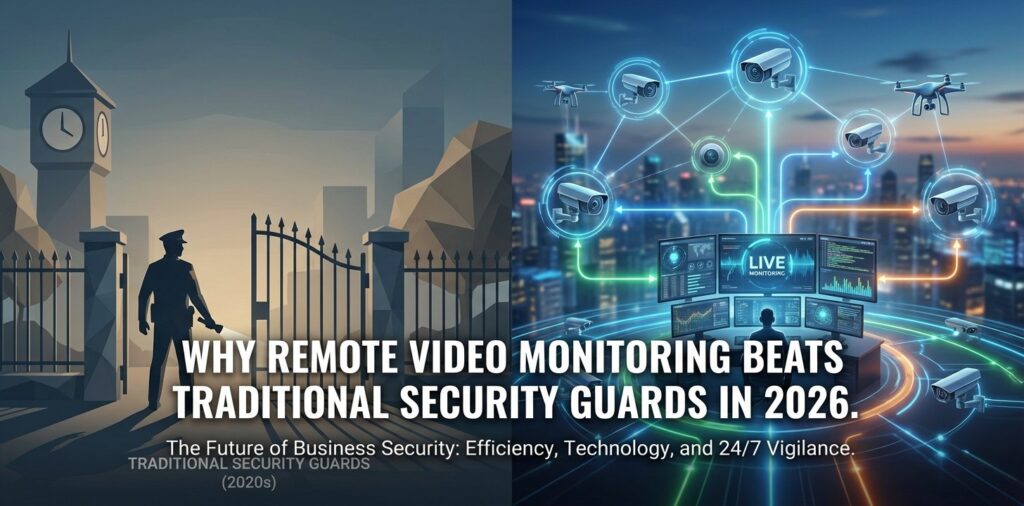
Why Remote Video Monitoring Beats Traditional Security Guards in 2026
The security landscape has fundamentally changed. Organizations across South Florida are increasingly questioning whether traditional security guard services deliver adequate return on investment. With remote video monitoring technology advancing rapidly and becoming more accessible, businesses face a critical decision: continue with conventional on-site guards or transition to intelligent monitoring solutions that offer superior coverage, consistency, and cost-effectiveness.
This analysis examines why remote video monitoring has emerged as the preferred security solution for commercial properties, HOAs, industrial facilities, and enterprise operations in 2026—and why this technology decisively outperforms traditional guard services in nearly every measurable category.
The Evolution of Commercial Security Solutions
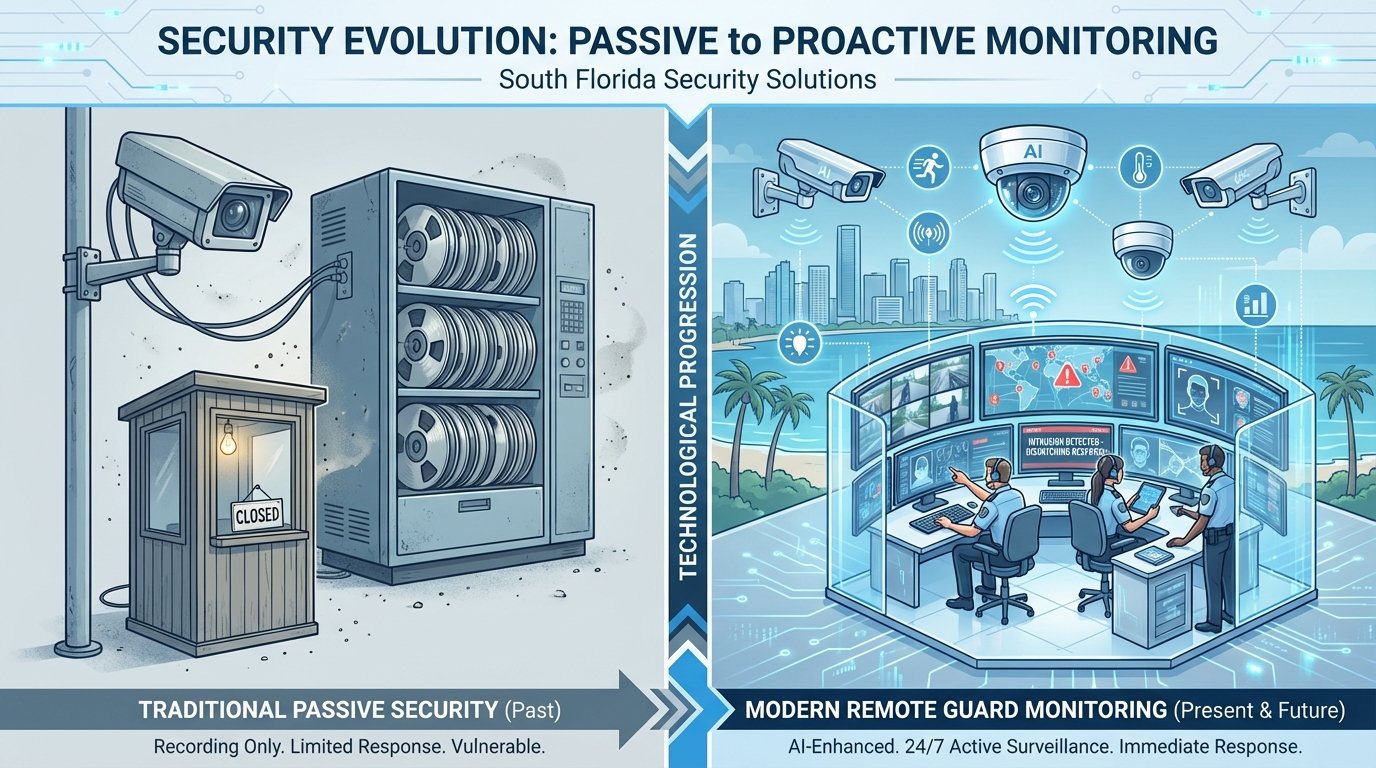
Remote guard monitoring represents a sophisticated integration of advanced camera systems, artificial intelligence, and trained security professionals working from centralized monitoring stations. Unlike passive video recording that simply captures footage for later review, live video monitoring South Florida provides active threat detection and immediate response capabilities around the clock.
Modern remote video monitoring systems employ high-resolution cameras with advanced analytics capabilities, thermal imaging, license plate recognition, and two-way audio communication. These systems connect to professional monitoring centers where trained operators oversee multiple properties simultaneously, responding instantly to detected threats while maintaining comprehensive documentation of all security events.
This technological advancement addresses the fundamental limitations inherent in traditional guard services while delivering capabilities that human patrols simply cannot match—regardless of how well-trained or conscientious individual guards might be.
Coverage Superiority: Complete Property Visibility
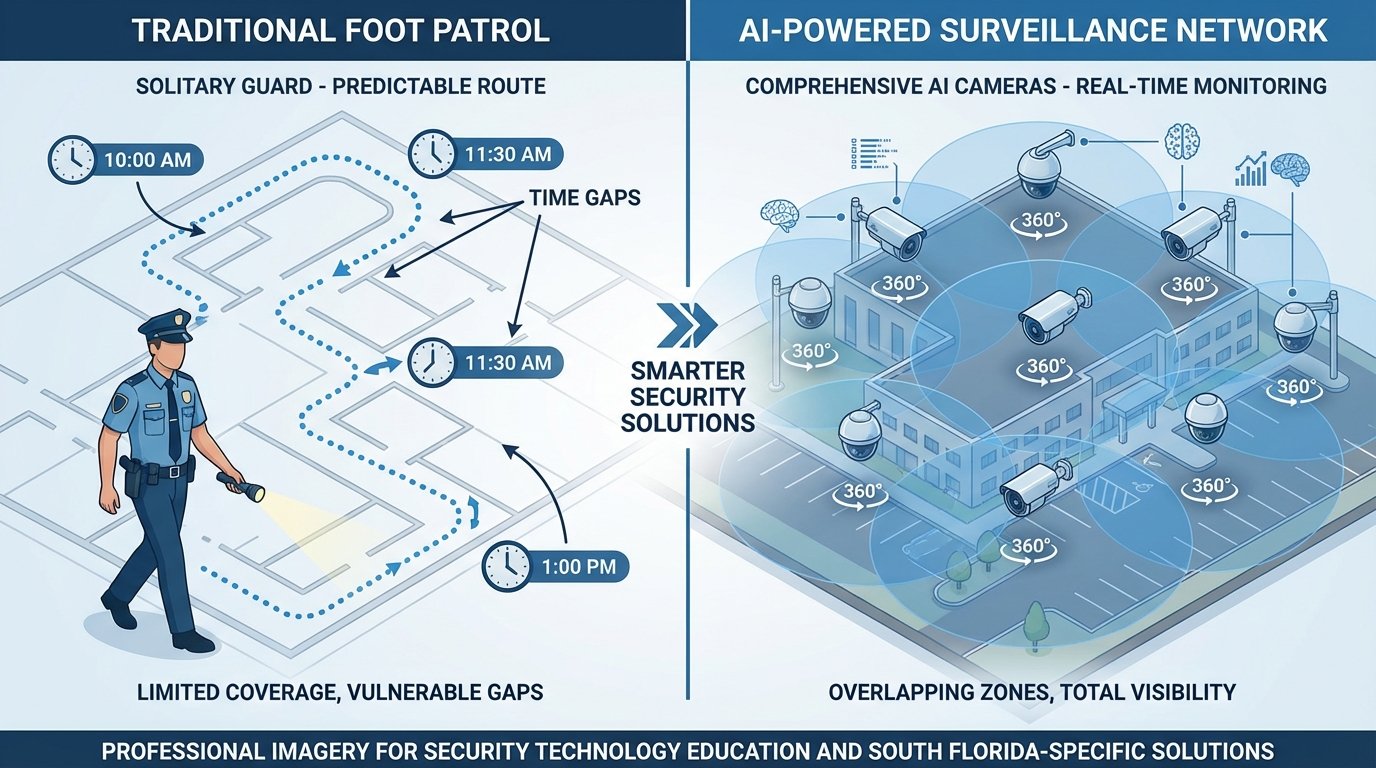
Traditional security guards face insurmountable physical limitations. A single guard can only be in one location at any given time, creating predictable patrol patterns that sophisticated intruders easily circumvent. Even teams of multiple guards cannot achieve comprehensive property coverage without significant expense.
Simultaneous Multi-Location Monitoring
Remote video monitoring eliminates this constraint entirely. A properly designed camera network provides continuous coverage of every critical area—entrances, loading docks, parking structures, perimeter fencing, storage areas, and interior spaces—simultaneously. No blind spots, no patrol gaps, no predictable patterns for criminals to exploit.
For a typical 50,000 square foot commercial facility, achieving equivalent coverage with guards would require four to six personnel working coordinated shifts. Remote monitoring accomplishes this with strategically positioned cameras and a single monitoring operator overseeing the entire property alongside other client sites.
Perimeter Protection and Early Threat Detection
Virtual security guard services excel at perimeter protection. Advanced analytics detect potential threats at property boundaries—long before intruders reach valuable assets or occupied buildings. Guards conducting physical patrols typically discover security breaches only after intrusions have occurred, significantly limiting response effectiveness.
Modern systems distinguish between genuine threats and benign activity. Artificial intelligence filters false alarms from wildlife, weather events, or authorized personnel, while immediately flagging suspicious behavior patterns that warrant human operator attention and response.
Consistency and Reliability: Eliminating Human Variables
Security effectiveness demands unwavering vigilance. Remote monitoring systems maintain perfect consistency regardless of circumstances, while human guard services inherently suffer from performance variability that compromises security.
No Fatigue, Distractions, or Performance Degradation
Security guards work long shifts—often overnight—during which alertness naturally diminishes. Boredom during quiet periods, personal distractions, and simple human fatigue create vulnerability windows that criminals exploit. Studies consistently show attention degradation during extended monitoring periods, regardless of individual commitment or professionalism.
Remote video monitoring systems never experience fatigue. Cameras maintain identical vigilance at 3 AM as at 3 PM. Monitoring center operators work optimized shifts with regular rotation, and multiple operators provide mutual oversight, ensuring consistent attention levels throughout every shift.
Eliminating Staffing Disruptions
Guard services face constant staffing challenges: sick days, vacation coverage, shift callouts, employee turnover, and training periods for new personnel. Each disruption creates security gaps or requires expensive overtime coverage. High turnover rates in the security industry—often exceeding 100% annually—mean properties frequently have inexperienced guards still learning facility layouts and protocols.
With 24/7 security monitoring services using remote technology, staffing disruptions at individual properties become irrelevant. Monitoring center operations maintain consistent coverage regardless of individual operator schedules, with multiple trained professionals always available.
Enhanced Response Capabilities and Documentation
Effective security requires more than detecting threats—it demands rapid, appropriate responses and comprehensive documentation for investigations, insurance claims, and legal proceedings.
Instant Assessment and Multi-Layer Response
When remote monitoring operators identify security threats, they immediately assess situations using multiple camera angles, zoom capabilities, and two-way audio communication. This comprehensive situational awareness enables precise response coordination—dispatching law enforcement with detailed threat information, activating on-site deterrents like lighting and sirens, and issuing verbal warnings to intruders.
Traditional guards must physically investigate disturbances, which introduces response delays and potential safety risks. Solo guards confronting multiple intruders face dangerous situations that compromise both security and personal safety. Remote operators coordinate responses without personal risk while providing law enforcement with real-time intelligence.
Complete Incident Documentation
Every security event captured by remote video monitoring creates permanent, time-stamped, high-definition documentation. This evidence proves invaluable for law enforcement investigations, insurance claims, legal proceedings, and security protocol improvements.
Guard reports depend on individual observation, memory, and documentation skills. Handwritten logs lack the detail and objectivity that video evidence provides. Disputes about incident timelines, participant actions, or security response effectiveness become moot when comprehensive video documentation exists.
Cost Effectiveness: Superior ROI for Security Investments
Budget realities drive many security decisions. Remote monitoring delivers superior protection at significantly lower costs than equivalent guard coverage, making advanced security accessible to organizations previously unable to afford comprehensive protection.
Direct Cost Comparison
Traditional security guard services in South Florida typically cost $25-40 per hour per guard, depending on experience level and special certifications. Achieving 24/7 coverage requires approximately 4.2 full-time equivalent positions (accounting for shift overlap, breaks, and time off), resulting in annual costs between $218,000 and $350,000 for single-guard coverage—more for properties requiring multiple simultaneous guards.
Remote video monitoring systems require upfront infrastructure investment—typically $15,000-50,000 depending on property size and complexity—followed by monthly monitoring fees ranging from $500-2,000 per month ($6,000-24,000 annually). Even factoring in initial installation costs amortized over five years, total annual expense remains dramatically lower than guard services while providing superior coverage.
Hidden Cost Elimination
Guard services carry hidden costs beyond hourly rates: payroll taxes, workers’ compensation insurance, liability coverage, overtime premiums, training expenses, uniform costs, and management overhead. Many organizations also maintain video surveillance systems alongside guard services, duplicating expenses.
Remote monitoring eliminates these variable costs. Monthly monitoring fees remain predictable and fixed, simplifying budget planning and eliminating surprise expenses from staffing issues or coverage gaps.
Scalability and Flexibility for Changing Needs
Business security needs evolve. Seasonal operations, construction projects, special events, and organizational growth require security solutions that adapt quickly without massive expense increases.
Rapid Coverage Adjustment
Expanding guard coverage requires recruiting, hiring, training, and onboarding new personnel—a process taking weeks or months. Reducing coverage creates personnel management challenges and potential unemployment claims.
Remote video monitoring scales efficiently. Adding cameras to cover new areas or temporary construction zones requires only equipment installation and monitoring center integration—typically accomplished within days. Seasonal businesses can adjust monitoring intensity without staffing complications, paying only for required service levels.
Technology Integration and Future-Proofing
Modern remote monitoring integrates seamlessly with other security systems: access control, intrusion detection, fire alarms, and building management platforms. This integration creates comprehensive security ecosystems where systems share intelligence and coordinate responses automatically.
As technology advances, remote monitoring systems receive capability upgrades through software updates and equipment enhancements. Guard services offer no comparable improvement path—performance remains fundamentally constrained by human limitations regardless of technological progress.
Specialized Capabilities Beyond Human Guards
Advanced remote monitoring systems provide security capabilities that human guards simply cannot replicate, regardless of training or dedication.
License Plate Recognition and Vehicle Tracking
Automated license plate recognition (LPR) systems integrated with remote monitoring identify and track every vehicle entering or exiting properties. This capability proves invaluable for access control, parking enforcement, investigation support, and threat assessment—automatically comparing plates against watchlists and alerting operators to vehicles associated with previous incidents.
Guards manually recording license plate information capture only a fraction of vehicle activity while diverting attention from other security responsibilities.
Advanced Analytics and Pattern Recognition
Video analytics detect anomalous behavior patterns that might escape human attention: vehicles lingering near sensitive areas, individuals accessing properties during unusual hours, objects left in restricted zones, or crowd formations suggesting potential problems.
These systems learn normal activity patterns for specific properties and automatically flag deviations warranting operator attention. This intelligence layer dramatically improves threat detection while reducing false alarms that plague conventional motion detection systems.
Thermal Imaging and Low-Light Performance
Modern cameras equipped with thermal imaging and advanced low-light sensors detect threats in complete darkness, through fog, and across long distances—environmental conditions that severely limit human guard effectiveness. This capability proves particularly valuable for large properties, perimeter monitoring, and facilities requiring 24/7 protection in all weather conditions.
Legal Liability and Risk Management
Security operations carry inherent liability risks. Remote monitoring significantly reduces exposure compared to on-site guard services.
Reducing Physical Confrontation Risks
Guards confronting intruders or handling disputes face situations that can escalate to violence, creating liability for excessive force, wrongful detention, assault claims, or inadequate response allegations. These incidents generate expensive litigation and potential judgment exposure regardless of ultimate outcome.
Remote operators coordinate responses without physical confrontation, directing law enforcement to handle dangerous situations while maintaining safe distance. Two-way audio systems allow operators to issue warnings and de-escalate situations verbally without physical presence.
Comprehensive Audit Trails
When security incidents lead to litigation or insurance claims, comprehensive video documentation and system logs provide objective evidence of actual events and response timelines. This documentation protects organizations against fraudulent claims while demonstrating appropriate security measures and response protocols.
Guard reports, while important, lack the objectivity and comprehensiveness that video evidence provides, sometimes creating “he said, she said” disputes that complicate claim resolution and legal defense.
Integration with Modern Security Ecosystems
Effective security demands integrated approaches where multiple systems work together seamlessly. Remote video monitoring serves as the central nervous system for comprehensive security platforms.
Access Control Integration
When remote monitoring integrates with access control systems, operators receive instant alerts for unauthorized access attempts, propped doors, forced entry, or unusual access patterns. Video verification confirms whether access events represent genuine security threats or technical issues, enabling appropriate response without unnecessary escalation.
Intrusion Detection Verification
Intrusion alarm systems generate significant false alarm rates—typically 90-98% according to industry data. Remote video monitoring provides instant visual verification, distinguishing genuine intrusions from false alarms before dispatching law enforcement. This verification reduces false alarm fines, preserves positive law enforcement relationships, and ensures appropriate resource allocation to actual threats.
Addressing Common Concerns About Remote Monitoring
Physical Deterrence Value
Some organizations worry that eliminating visible guards reduces deterrence. Evidence suggests otherwise. Prominently displayed cameras with clear signage indicating live monitoring provide substantial deterrent effect—criminals recognize that remote monitoring systems provide comprehensive coverage without patrol gaps or predictable patterns.
Many remote monitoring services offer virtual guard tours with automated voice announcements and visible camera movements that demonstrate active monitoring, combining deterrence with comprehensive coverage.
Emergency Response Capabilities
Critics sometimes claim guards provide superior emergency response—rendering first aid, operating fire extinguishers, or guiding evacuations. In reality, remote monitoring operators coordinate professional emergency services with detailed situational intelligence and real-time guidance, typically producing faster and more effective emergency response than single guards with limited training and equipment.
Customer Service Functions
Guards sometimes perform customer service roles—providing directions, accepting deliveries, or assisting visitors. Organizations requiring these services should evaluate whether dedicated customer service personnel or reception staff provide better value than security guards performing non-security duties. Remote monitoring can supplement rather than replace personnel when legitimate customer service needs exist.
Implementation Considerations for South Florida Properties
Organizations considering remote video monitoring should understand implementation requirements for successful deployments.
Professional System Design
Effective remote monitoring requires professionally designed camera placement, appropriate equipment selection, adequate network infrastructure, and proper lighting. Working with experienced security integration companies ensures systems deliver promised capabilities without blind spots or technical limitations that compromise effectiveness.
Monitoring Center Quality
Not all monitoring centers provide equivalent service. Organizations should verify monitoring center certifications, operator training programs, response protocols, and service level agreements. UL-listed monitoring centers meet rigorous operational standards that ensure consistent quality and reliability.
Hybrid Approaches for Specific Needs
Some facilities benefit from hybrid approaches combining remote monitoring with limited on-site presence for specific functions. Distribution centers might employ gate attendants for vehicle direction while relying on remote monitoring for comprehensive security. This targeted approach maximizes cost-effectiveness while addressing unique operational requirements.
The Future of Commercial Security
Remote video monitoring represents the present and future of commercial security. Artificial intelligence capabilities continue advancing, with predictive analytics, behavioral recognition, and automated threat assessment becoming increasingly sophisticated. Integration with access control, building management, and emergency response systems creates comprehensive security ecosystems that surpass anything achievable with traditional guard services.
Organizations clinging to conventional guard services increasingly find themselves at competitive disadvantages—paying premium costs for inferior protection while competitors deploy advanced technology solutions that deliver superior results at lower expense.
Making the Transition: Next Steps
Evaluating remote video monitoring for your organization starts with comprehensive security assessment. Professional security integrators analyze facility layouts, identify vulnerability points, assess current security measures, and design systems optimized for specific protection requirements and operational characteristics.
This assessment process typically reveals security gaps in current approaches while demonstrating how remote monitoring addresses limitations that organizations have simply accepted as inevitable aspects of traditional security programs.
The evidence overwhelmingly favors remote monitoring over traditional guards for most commercial applications. Superior coverage, unwavering consistency, enhanced capabilities, comprehensive documentation, significant cost savings, and reduced liability combine to deliver security solutions that traditional approaches simply cannot match.
For South Florida businesses, HOAs, and commercial properties seeking maximum protection with optimal resource utilization, remote video monitoring has evolved from innovative alternative to essential standard. Organizations still relying exclusively on traditional guard services should carefully examine whether they’re receiving adequate security value or simply maintaining outdated approaches because “that’s how we’ve always done it.”
TechPro Security Products specializes in designing and implementing professional remote video monitoring solutions for commercial properties throughout South Florida. Our security integration experts assess your specific requirements, design optimal camera placement and system architecture, and coordinate with certified monitoring centers to deliver comprehensive protection that exceeds guard services while reducing security expenses. Contact us today for a complimentary security assessment and discover how remote monitoring can transform your property protection while improving your bottom line.