
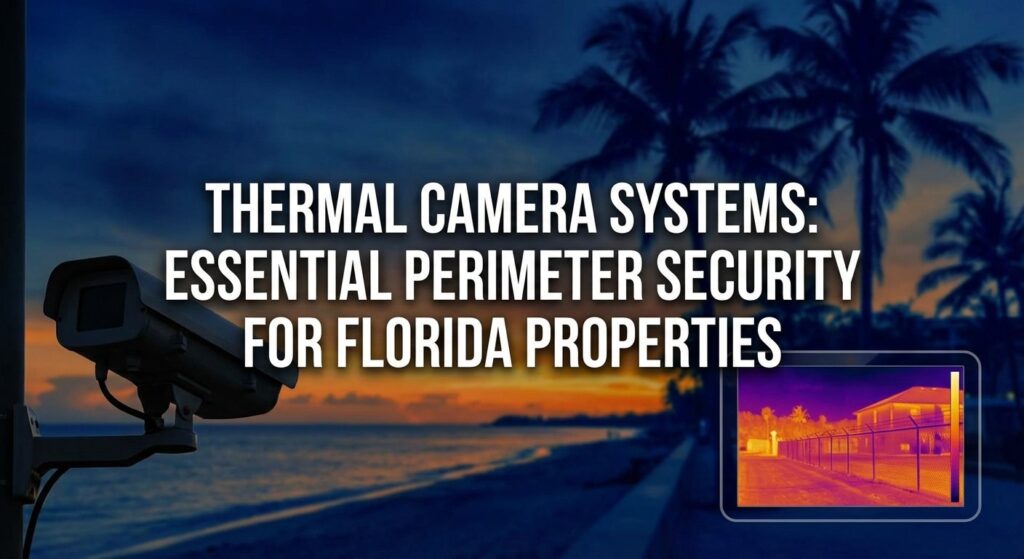
Thermal Camera Systems: Essential Perimeter Security for Florida Properties
Property owners across South Florida face unique security challenges that conventional surveillance systems often fail to address. Expansive perimeters, dense vegetation, challenging lighting conditions, and year-round outdoor activity create blind spots that intruders can exploit. Thermal camera systems have emerged as a game-changing solution for perimeter security protection systems, offering capabilities that visible-light cameras simply cannot match.
Unlike traditional security cameras that rely on ambient light or infrared illumination, thermal imaging cameras detect heat signatures emitted by people, vehicles, and animals. This fundamental difference makes them extraordinarily effective for monitoring property lines, detecting unauthorized access, and providing reliable security coverage in conditions where conventional cameras struggle or fail completely.
Why Thermal Technology Excels at Perimeter Security
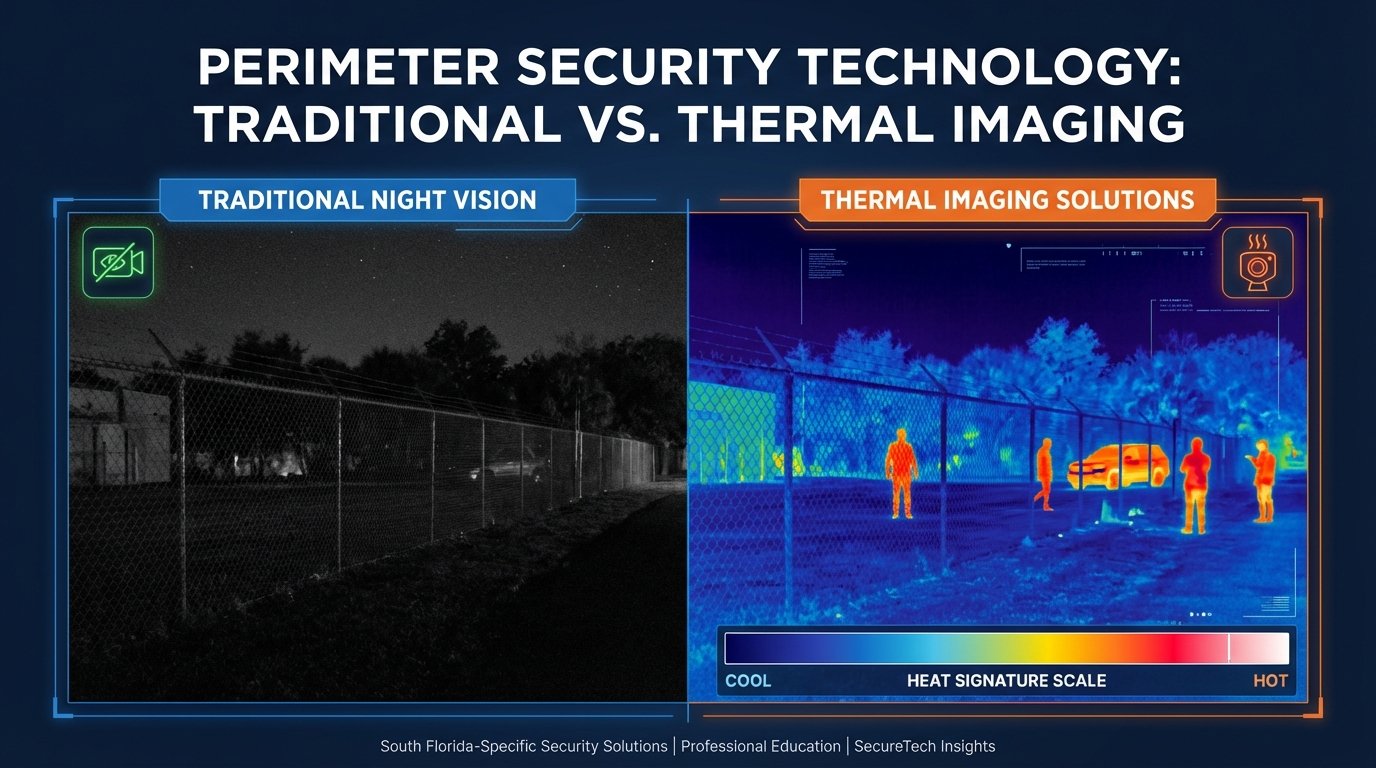
Thermal imaging cameras operate by detecting infrared radiation—essentially heat—emitted by all objects above absolute zero. The warmer an object, the more infrared radiation it emits. This technology creates images based on temperature differences rather than visible light, fundamentally changing what security systems can detect and when they can detect it.
For perimeter intrusion detection, this capability delivers several critical advantages. Thermal cameras perform identically whether it’s noon or midnight, eliminating the vulnerabilities associated with darkness. They see through light fog, smoke, and haze that would obscure visible-light cameras. Most importantly, they detect the heat signature of an intruder even when that person is hidden behind bushes, shrubs, or other vegetation—a common concealment tactic in South Florida’s lush landscapes.
The technology also dramatically reduces false alarms. Advanced thermal systems can distinguish between a person approaching your property line and a palm frond swaying in the breeze, a distinction that motion-activated visible-light cameras frequently miss. This differentiation capability becomes especially valuable for commercial properties, HOAs, and residential estates where nuisance alarms waste security resources and desensitize response teams.
Critical Applications for Florida Commercial Properties
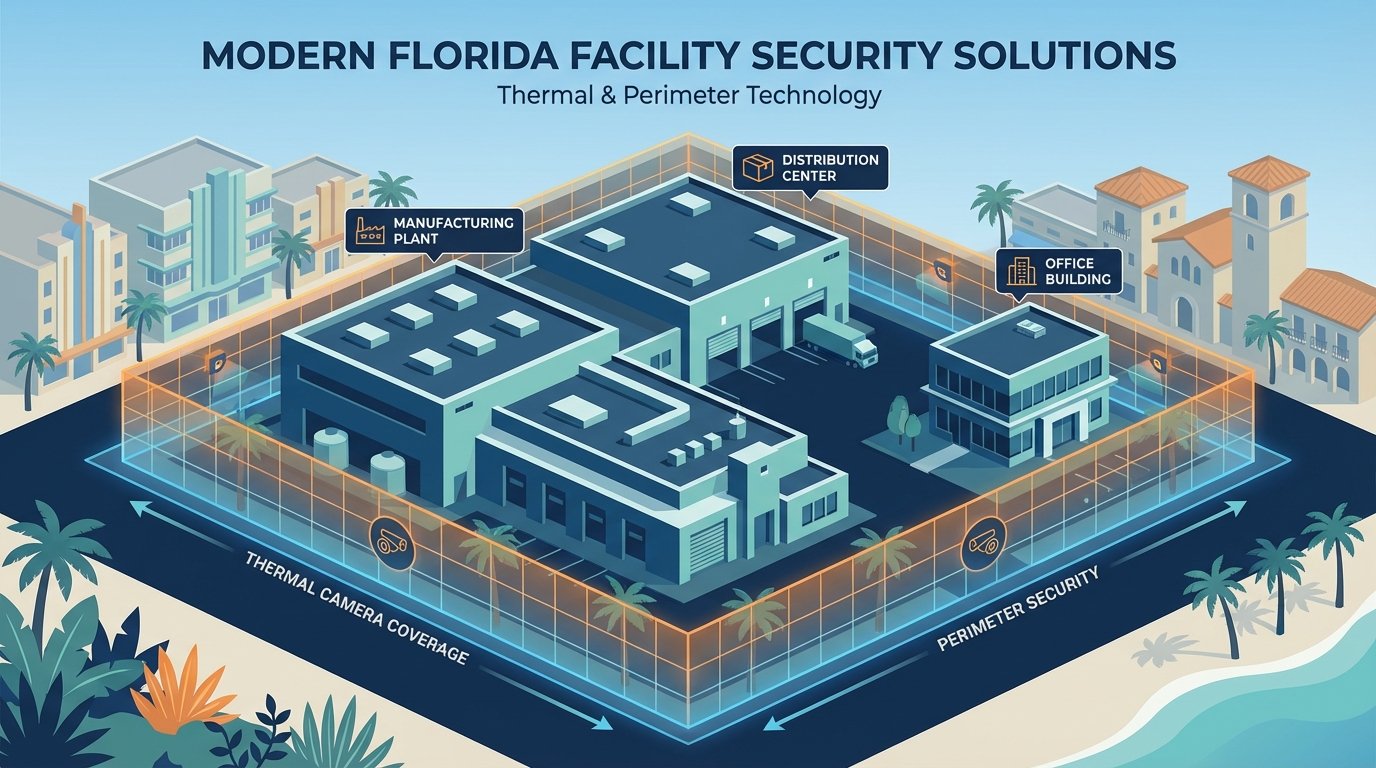
Commercial facilities throughout South Florida have specific perimeter security requirements that make thermal camera systems particularly valuable. Manufacturing plants, distribution centers, utility facilities, and office parks often feature extensive perimeters that are expensive to fence and patrol. Property line security cameras using thermal technology can monitor these areas with fewer camera installations compared to conventional systems, reducing both initial investment and ongoing maintenance costs.
Industrial and Manufacturing Facilities
Industrial properties typically have valuable equipment, raw materials, and finished products stored outdoors or in easily accessible buildings. Thermal perimeter security protection systems create virtual tripwires along fence lines, around equipment yards, and at loading docks. When someone crosses these defined boundaries during off-hours, security personnel receive immediate alerts with visual confirmation of the intrusion.
The long-range detection capability of thermal cameras—some models can identify human-sized objects at distances exceeding 1,000 feet—allows comprehensive coverage of large industrial sites with strategic camera placement. This extended range is especially important in South Florida, where sprawling facilities are common and where monitoring every corner of a property with traditional cameras would require prohibitive numbers of devices.
Critical Infrastructure and Utilities
Water treatment plants, electrical substations, telecommunications facilities, and other critical infrastructure require the highest levels of perimeter security. Thermal imaging cameras Florida installations at these facilities provide early warning of potential security breaches, giving security teams time to respond before intruders reach sensitive areas.
For these applications, thermal systems integrate with access control platforms, alerting systems, and video management software to create layered security architectures. When someone approaches a restricted perimeter, thermal cameras detect the intrusion, visible-light PTZ (pan-tilt-zoom) cameras automatically slew to the location for visual identification, and access control systems lock down entry points—all within seconds of initial detection.
Educational Institutions and Healthcare Campuses
Universities, colleges, and hospital campuses present unique security challenges. These environments need robust perimeter security while maintaining an open, welcoming atmosphere during operational hours. Thermal camera systems provide invisible security that doesn’t create a fortress mentality while still protecting students, patients, staff, and visitors.
After-hours monitoring becomes particularly effective with thermal technology. Campus security can define specific zones that should have no pedestrian traffic during certain hours. Any thermal signature entering these zones triggers alerts, allowing security personnel to intercept unauthorized visitors before incidents occur.
Residential Applications: Estates and HOA Communities
High-value residential properties and planned communities increasingly deploy thermal perimeter security to protect residents and assets. Large estate properties with extensive grounds benefit from the same long-range detection capabilities that serve commercial facilities. A single thermal camera positioned strategically can monitor hundreds of feet of property line, detecting anyone attempting to approach the main residence from wooded areas or waterfront access points.
Homeowners’ associations and master-planned communities use thermal imaging cameras to monitor community perimeters, club facilities, and amenity areas. These installations protect community assets while also providing evidence for trespassing enforcement. The reduced false alarm rate of thermal systems is especially valuable in residential applications, where excessive nuisance alarms lead to neighbor complaints and diminished confidence in security systems.
Overcoming South Florida’s Unique Environmental Challenges
South Florida’s subtropical environment creates specific challenges that make thermal technology particularly appropriate for perimeter security protection systems. The region’s frequent afternoon thunderstorms, morning fog along waterways, and dense vegetation all compromise conventional camera effectiveness.
Thermal cameras maintain functionality during heavy rain when visible-light cameras show only sheets of water obscuring the scene. While extreme rainfall does reduce thermal camera range, they continue providing usable imagery in conditions that render conventional cameras virtually useless. This weather resilience ensures perimeter security remains operational during the very conditions when intrusions are most likely—when intruders expect reduced visibility to provide cover.
The prevalence of waterfront properties along Florida’s coast, canals, and lakes creates additional security considerations. Thermal cameras excel at detecting approaching vessels or individuals in the water, applications where conventional cameras struggle with glare from water surfaces and challenging lighting transitions between water and land. Marina facilities, waterfront estates, and canal communities benefit significantly from thermal perimeter monitoring that covers both land and water approaches.
Integration with Comprehensive Security Architectures
Thermal camera systems deliver maximum value when integrated into comprehensive security platforms rather than operating as standalone solutions. Professional security integration combines thermal perimeter detection with visible-light verification cameras, access control systems, intrusion detection panels, and central monitoring stations.
This layered approach leverages each technology’s strengths. Thermal cameras provide initial detection and tracking across wide areas. When thermal systems detect an intrusion, they trigger visible-light PTZ cameras that zoom to the location, capturing facial details and clothing descriptions that thermal imagery cannot provide. Simultaneously, the system can activate perimeter lighting, sound warnings, and notify security personnel—all automated through integrated security management platforms.
Modern thermal imaging cameras communicate via standard network protocols, making them compatible with enterprise video management systems. Security teams monitor thermal and visible-light cameras through unified interfaces, simplifying operations and ensuring alerts are recognized and addressed promptly. This interoperability also future-proofs investments, as thermal cameras can integrate with existing security infrastructure rather than requiring parallel systems.
Advanced Analytics and AI-Enhanced Detection
Contemporary thermal camera systems incorporate sophisticated analytics that dramatically improve detection accuracy and reduce operator workload. Video analytics engines can classify detected objects as people, vehicles, or animals, applying different response protocols based on the classification.
For example, a thermal system monitoring a corporate campus perimeter might ignore animals, log vehicles for later review, but immediately alert security when detecting pedestrians in restricted zones after business hours. This intelligent filtering eliminates alert fatigue while ensuring genuine security threats receive immediate attention.
Advanced systems also track objects across multiple camera views, maintaining continuity as an intruder moves along the perimeter. This tracking capability provides security teams with complete situational awareness—knowing not just that someone is on the property, but where they entered, what path they’re following, and what assets they’re approaching.
Behavioral analytics add another intelligence layer, identifying suspicious activities such as loitering near perimeter fences, repeated approaches and retreats, or individuals attempting to find camera blind spots. These pre-incident indicators allow security teams to intervene before actual breaches occur, preventing losses rather than merely documenting them.
Comparing Thermal Systems to Alternative Technologies
Property owners evaluating perimeter intrusion detection options frequently compare thermal cameras with alternative technologies including radar systems, fiber optic sensing cables, microwave barriers, and conventional video analytics.
Radar systems excel at detecting motion across wide areas but cannot provide visual imagery confirming what triggered an alert. Thermal cameras detect and display the heat signature, giving operators immediate visual confirmation. Buried fiber optic cables detect vibrations from someone climbing a fence but offer no tracking capability once the perimeter is breached. Thermal systems track intruders continuously from initial detection through the entire property.
Conventional video analytics applied to visible-light cameras have improved substantially but remain dependent on adequate lighting and clear atmospheric conditions. Thermal imaging cameras Florida installations operate effectively regardless of lighting and maintain functionality in conditions that degrade visible-light performance.
The optimal approach for many facilities combines complementary technologies. Thermal cameras provide primary detection and tracking, while buried sensors confirm fence-line breaches, and visible-light cameras capture identifying details. Professional security integrators design systems that leverage multiple technologies’ strengths while mitigating individual weaknesses.
Selecting Appropriate Thermal Camera Specifications
Thermal cameras vary significantly in capabilities and pricing, making proper specification essential for cost-effective deployments. The key technical specifications affecting performance include thermal sensor resolution, lens focal length, thermal sensitivity, and image processing capabilities.
Resolution in thermal cameras is measured in pixels, similar to visible-light cameras, but typical resolutions are lower—often ranging from 320×240 to 640×480 pixels for security applications. While these resolutions seem modest compared to megapixel visible-light cameras, thermal images contain different information. A 640×480 thermal camera provides sufficient detail to detect and classify objects at substantial distances.
Lens selection determines the field of view and detection range. Wide-angle lenses cover broader areas but detect targets at shorter distances. Telephoto lenses provide extended range but narrower coverage. Professional security assessments determine the optimal lens configurations based on property layout, critical assets, and threat scenarios.
Thermal sensitivity—measured in millikelvins (mK)—indicates the smallest temperature difference the camera can detect. More sensitive cameras distinguish subtle temperature variations, improving detection of partially concealed targets or individuals wearing insulated clothing. Quality thermal cameras for perimeter security typically offer sensitivity below 50mK.
Professional Installation and Ongoing Optimization
Effective thermal perimeter security protection systems require professional design, installation, and configuration. Unlike conventional security cameras where adequate coverage might be achieved through trial and error, thermal camera placement demands precise calculation of detection ranges, lens selections, and mounting heights.
Professional security integrators use specialized software to model thermal camera coverage based on property dimensions, topography, vegetation, and security requirements. These models predict detection ranges under various conditions, identify potential blind spots, and optimize camera placement for comprehensive coverage with minimum equipment investment.
Proper installation also addresses environmental factors affecting long-term reliability. South Florida’s salt air environments require appropriate enclosure ratings and corrosion-resistant mounting hardware. Lightning protection, surge suppression, and proper grounding protect expensive thermal cameras from the region’s frequent electrical storms. Network infrastructure must provide sufficient bandwidth for thermal video streams while maintaining cybersecurity standards that prevent unauthorized access.
Following installation, thermal systems require calibration and optimization. Technicians establish detection zones, configure analytics rules, set alert thresholds, and integrate thermal cameras with broader security management platforms. This configuration process ensures the system matches the facility’s operational patterns and security protocols.
Maintenance Requirements and Long-Term Reliability
Thermal imaging cameras generally require less maintenance than conventional security cameras due to their simpler optical systems and absence of illumination requirements. However, regular maintenance ensures optimal performance and extends system lifespan.
Quarterly inspections should verify that camera lenses remain clean and unobstructed, mounting brackets stay secure, and network connections maintain stability. Environmental factors like spider webs, bird nests, or vegetation growth can obstruct thermal camera views just as they affect conventional cameras. The tropical growth rates common in South Florida make vegetation management particularly important—even thermal cameras cannot see through thick vine growth covering the lens housing.
Annual professional maintenance includes firmware updates, analytics recalibration, and integration testing with connected security systems. As properties evolve—new buildings, landscape changes, modified operational patterns—security integrators adjust thermal camera configurations to maintain optimal coverage and appropriate alert parameters.
Regulatory Compliance and Privacy Considerations
Thermal camera deployments must consider privacy regulations and community standards. While thermal imaging does not capture facial features or identifying details visible in conventional video, it does monitor individuals’ presence and movements. Professional installations include appropriate signage notifying people that perimeter security systems are in operation.
For commercial properties, thermal perimeter monitoring typically focuses on property boundaries and restricted areas rather than employee work zones or public spaces. This targeted deployment protects assets and prevents intrusions while respecting employee privacy expectations. HOA communities should establish clear policies regarding thermal camera coverage, data retention, and access to recorded imagery before implementation.
Many industries face specific regulatory requirements affecting security system deployments. Healthcare facilities must ensure perimeter security systems comply with HIPAA requirements for protecting sensitive areas. Financial institutions follow regulatory guidance about monitoring cash handling areas and vaults. Educational institutions consider student privacy protections when deploying campus security systems. Experienced security integrators understand these regulatory frameworks and design compliant solutions.
Return on Investment and Business Value
Thermal camera systems represent significant investments, but they deliver measurable returns through loss prevention, reduced security staffing requirements, and insurance benefits. A single prevented intrusion at a commercial facility can justify the entire thermal perimeter security investment if that incident would have resulted in equipment theft, vandalism, or business interruption.
The reduced false alarm rate of thermal systems decreases wasted security response costs. When conventional motion-activated cameras generate dozens of false alarms nightly from insects, weather, or vegetation movement, security personnel become desensitized to alerts. Thermal systems with properly configured analytics generate far fewer nuisance alarms, ensuring genuine security events receive appropriate attention.
Some insurance carriers offer premium reductions for commercial properties with certified perimeter security systems. The specific reductions vary by carrier and property type, but they can offset ongoing system monitoring costs. Property owners should consult insurance providers about potential benefits when planning thermal security installations.
Working with Professional Security Integrators
Thermal camera systems demand expertise that exceeds typical security camera installation capabilities. Professional security integration companies bring essential value through proper system design, equipment selection, installation quality, and ongoing support.
Qualified integrators assess properties comprehensively, identifying vulnerabilities, understanding operational patterns, and recommending solutions that address specific threats. They specify appropriate thermal camera models, lens configurations, and analytics capabilities matched to each application rather than applying one-size-fits-all approaches.
Licensed security contractors also ensure installations meet electrical codes, building regulations, and industry standards. They obtain necessary permits, coordinate with other trades, and document systems properly for future maintenance and modifications. This professional approach prevents problems that plague amateur installations and ensures long-term system reliability.
Ongoing relationships with professional integrators provide access to technical support when issues arise, system expansion as needs evolve, and technology updates as capabilities advance. Thermal imaging technology continues developing rapidly, and experienced integrators help clients leverage new capabilities while protecting existing investments.
Future Trends in Thermal Perimeter Security
Thermal imaging technology continues advancing, with improvements in resolution, sensitivity, analytics capabilities, and cost-effectiveness making systems increasingly accessible. Emerging trends include multispectral cameras that combine thermal and visible-light sensors in single housings, providing detection and identification capabilities in integrated devices.
Artificial intelligence and machine learning are enhancing thermal analytics, enabling systems to recognize increasingly sophisticated behavioral patterns and distinguish genuine threats from benign activities with greater accuracy. Cloud-based management platforms are simplifying multi-site monitoring, allowing organizations with distributed properties to oversee perimeter security from centralized operations centers.
The integration of thermal perimeter security with drone detection systems, license plate recognition, and facial recognition creates comprehensive security ecosystems that address evolving threats. As these technologies mature and integrate more seamlessly, property owners gain increasingly capable security solutions that provide both protection and operational intelligence.
Protecting Your South Florida Property with Thermal Technology
Perimeter security represents the critical first layer in comprehensive property protection strategies. Thermal camera systems provide capabilities that conventional technologies cannot match, detecting intrusions in darkness, adverse weather, and challenging environments while minimizing false alarms that undermine security effectiveness.
For South Florida commercial properties, HOA communities, and high-value estates, thermal imaging cameras offer proven solutions to persistent security challenges. The technology’s ability to function reliably in the region’s unique environmental conditions while integrating with broader security platforms makes it an increasingly essential component of professional security designs.
Professional security integration ensures thermal systems deliver their full potential through proper design, specification, installation, and configuration. The expertise and experience that licensed security contractors provide translates directly into more effective protection, better return on investment, and long-term system reliability.
TechPro Security Products specializes in designing and installing comprehensive perimeter security protection systems for South Florida commercial and residential properties. Our team of licensed security professionals brings extensive experience with thermal imaging cameras, perimeter intrusion detection, and integrated security platforms. Contact us today to schedule a professional security assessment and discover how thermal camera technology can enhance protection for your property.