
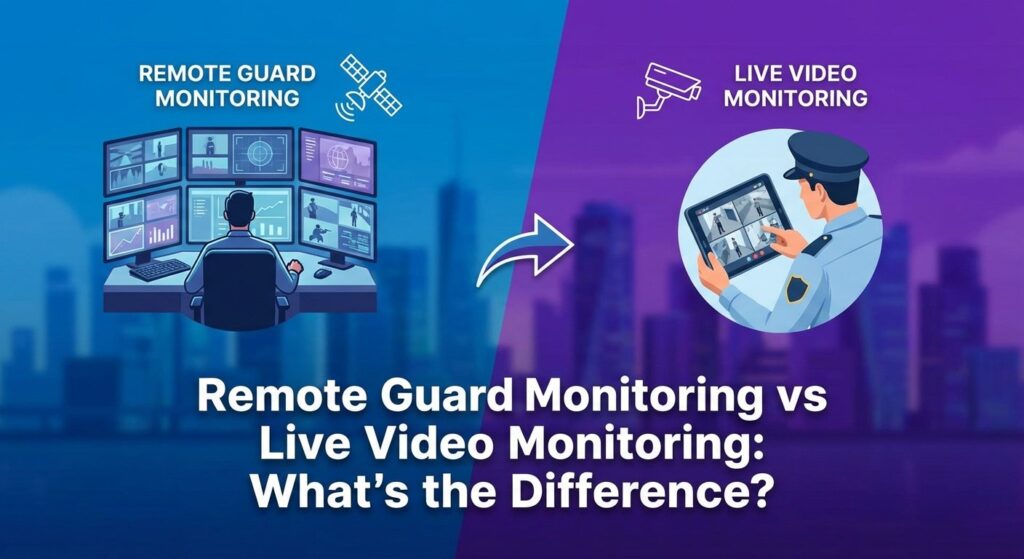
The security industry has evolved dramatically, with video monitoring solutions becoming more sophisticated and accessible than ever. However, confusion often arises when businesses and property managers encounter terms like “remote guard monitoring,” “live video monitoring,” and “remote video monitoring.” While these phrases sound similar, they represent distinctly different security approaches with varying levels of human involvement, response capabilities, and cost structures.
Understanding these differences is critical for making informed decisions about protecting your South Florida property. The wrong choice could mean paying for services you don’t need or, worse, discovering gaps in your security coverage when it matters most.
Understanding the Terminology: Breaking Down Security Monitoring Types
The security monitoring landscape includes several distinct service models, each with specific characteristics and capabilities. Before diving into comparisons, it’s essential to establish clear definitions.
What is Remote Video Monitoring?
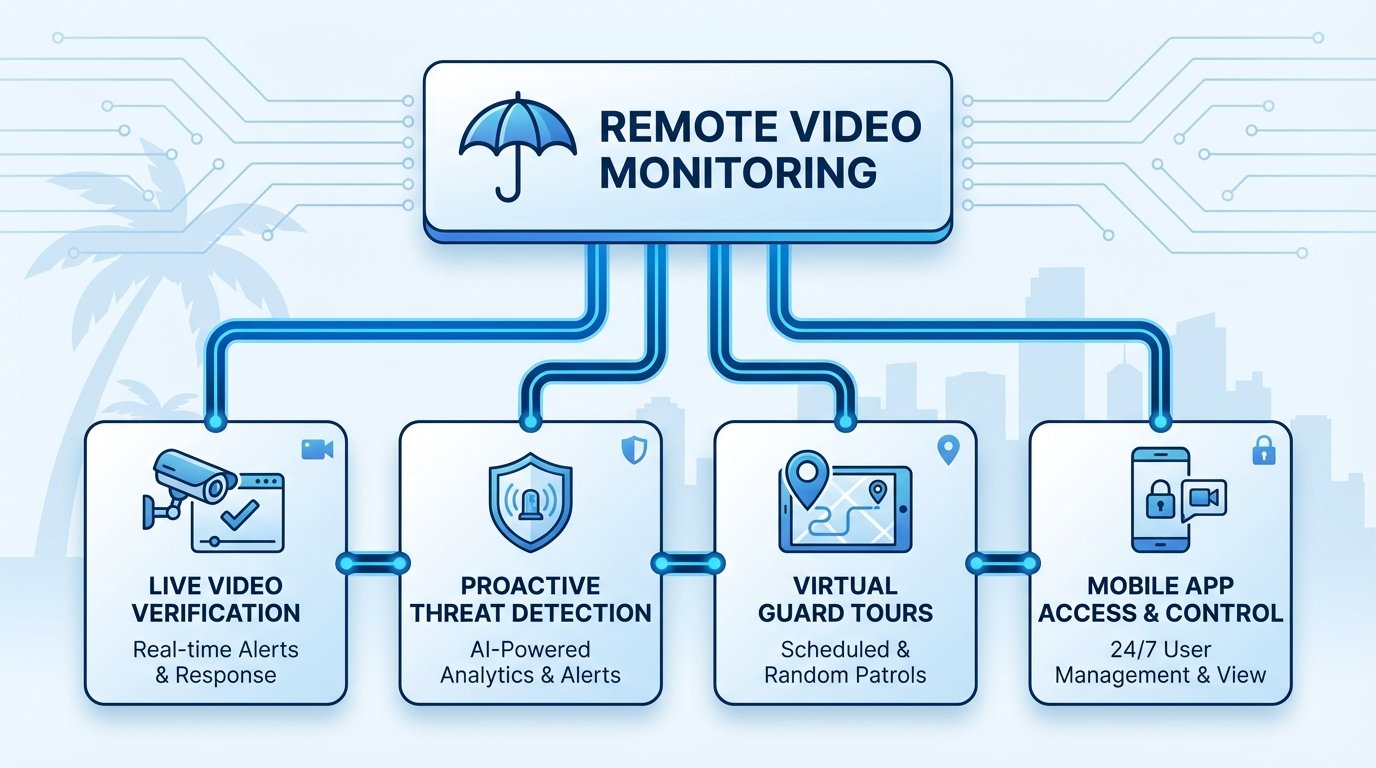
Remote video monitoring serves as the umbrella term for any security system where cameras transmit footage to an off-site location for viewing and analysis. This broad category encompasses various service levels, from basic cloud-recorded systems to sophisticated monitored solutions. The key characteristic is that someone or something reviews video footage from a location other than the protected property.
Remote video monitoring systems typically include network-connected cameras, video recording equipment or cloud storage, internet connectivity for data transmission, and remote access capabilities. The level of active monitoring varies significantly depending on the specific service model selected.
What is Live Video Monitoring?
Live video monitoring represents a more specific service where trained security professionals actively watch camera feeds in real-time during specified hours or on a 24/7 basis. Unlike passive recording systems that only capture footage for later review, live video monitoring involves human operators continuously observing multiple camera feeds.
This approach provides immediate human interpretation of events as they unfold. Operators can distinguish between genuine security threats and false alarms, such as animals triggering motion sensors or weather-related movements. When suspicious activity occurs, monitoring personnel follow established protocols, which may include issuing audio warnings through connected speakers, contacting property managers or law enforcement, or documenting incidents for evidence.
Live video monitoring services generally operate from centralized monitoring stations where operators oversee multiple client properties simultaneously. These facilities employ trained personnel working in shifts to provide continuous coverage.
What is Remote Guard Monitoring?
Remote guard monitoring, sometimes called virtual guard services, combines live video monitoring with proactive security interventions. This service model goes beyond passive observation to actively deter, prevent, and respond to security incidents in real-time.
Remote guards use advanced camera systems with two-way audio capabilities, allowing them to verbally challenge trespassers, issue warnings, and take immediate action. The service integrates multiple technologies including high-definition cameras with pan-tilt-zoom capabilities, intelligent video analytics that detect unusual patterns or behaviors, two-way audio communication systems, and integration with access control and alarm systems.
The distinguishing characteristic of remote guard monitoring is the proactive security posture. Rather than simply observing and reporting, remote guards actively engage with potential threats before they escalate into serious incidents.
Key Differences Between Remote Guard Monitoring and Live Video Monitoring
While both services involve human operators watching video feeds remotely, several critical differences separate remote guard monitoring from standard live video monitoring.
Level of Intervention
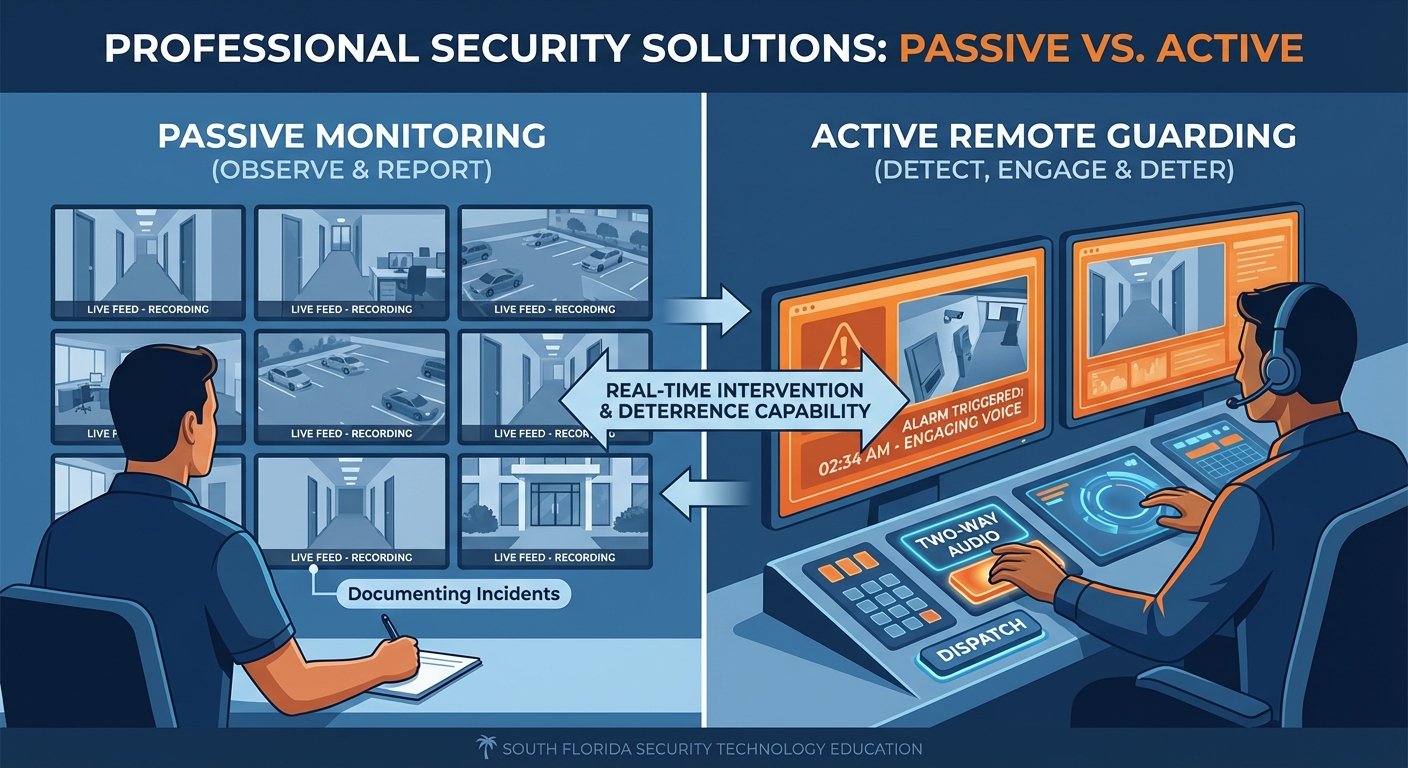
The most significant distinction lies in intervention capabilities. Live video monitoring personnel primarily observe and report. When they detect suspicious activity, their response typically involves calling the property owner, manager, or local authorities to inform them of the situation. The monitoring personnel do not directly interact with individuals on the property.
Remote guard monitoring takes a more assertive approach. Operators can speak directly to people on the property through two-way audio systems, issue verbal warnings to trespassers, activate sirens or lighting to deter intruders, and guide authorized personnel through security procedures. This direct intervention often stops security breaches before they result in theft, vandalism, or other losses.
Response Time
Response time differences can be substantial. Live video monitoring involves an additional step in the response chain. The operator must detect the incident, make a decision to escalate, contact the appropriate authority, and then wait for that authority to respond. This process can take several minutes or longer, depending on circumstances.
Remote guard monitoring eliminates intermediary steps. The moment suspicious activity is detected, the remote guard can immediately challenge the individual, often preventing the incident from escalating. Studies show that direct verbal challenges from remote guards stop approximately 75-90% of security incidents without requiring law enforcement dispatch.
Technology Requirements
Both services require quality cameras and reliable internet connectivity, but remote guard monitoring demands more sophisticated infrastructure. The system must support bidirectional audio communication, typically requires cameras with better resolution and lighting capabilities for nighttime identification, often incorporates advanced video analytics for automated alert generation, and needs integration capabilities with other security systems like access control.
Live video monitoring can function with more basic camera systems, though higher quality equipment still improves effectiveness. The technology requirements are less demanding because operators primarily observe rather than interact.
Cost Structure
The investment differences between these services reflect their capability differences. Live video monitoring typically costs less because it requires fewer technological integrations and operators can monitor more properties simultaneously with less intensive focus on each location.
Remote guard monitoring commands higher monthly fees due to the advanced technology requirements, more intensive operator attention per property, specialized training for security personnel, and greater liability assumed by the monitoring company. However, many businesses find that remote guard monitoring reduces total security costs by eliminating or reducing the need for on-site security personnel, which represents a significantly larger expense.
Coverage Patterns
Live video monitoring services often provide coverage during specific high-risk periods, such as overnight hours or weekends when properties are unoccupied. Clients may select limited monitoring schedules to manage costs, with cameras simply recording during unmonitored periods.
Remote guard monitoring typically operates as a comprehensive 24/7 security monitoring service. The proactive nature of the service and its role as a primary security measure rather than a supplemental one makes continuous coverage more common. Properties relying on remote guards as their primary security solution need consistent protection rather than intermittent monitoring.
Which Solution Fits Your Security Needs?
Selecting between remote guard monitoring and live video monitoring depends on multiple factors specific to your property, operations, and risk profile.
Consider Live Video Monitoring When:
- Your property already has on-site security personnel, and video monitoring supplements their coverage
- Budget constraints limit security spending, and you need cost-effective baseline monitoring
- The primary goal is documentation and evidence collection rather than active prevention
- Your property has low to moderate security risk levels
- You need monitoring only during specific high-risk periods
- Multiple security layers already exist, and video monitoring adds redundancy
Consider Remote Guard Monitoring When:
- Active theft prevention and immediate incident response are priorities
- Replacing or supplementing expensive on-site security guards makes financial sense
- Your property experiences frequent trespassing or vandalism requiring proactive deterrence
- Immediate verification of alarm events is necessary to reduce false police dispatches
- Your operations require comprehensive 24/7 security monitoring services
- Multiple high-value assets need protection across a large property footprint
Industry-Specific Considerations
Different industries face unique security challenges that influence which monitoring approach works best. Construction sites frequently suffer from equipment theft and after-hours trespassing, making remote guard monitoring with direct intervention capabilities particularly effective. The ability to challenge trespassers immediately often prevents theft before it occurs.
Manufacturing facilities typically need comprehensive security during production and non-production hours. Remote guard monitoring integrates well with access control systems, verifying authorized entry while challenging unauthorized access attempts. The 24/7 nature of remote guards aligns with manufacturing security requirements.
Retail properties and shopping centers benefit from live video monitoring during business hours for loss prevention and customer safety documentation, potentially transitioning to remote guard monitoring during closed hours when theft and vandalism risks increase.
Warehouses and distribution centers storing valuable inventory face significant theft risks, particularly during overnight hours. Remote guard monitoring provides cost-effective perimeter security across large footprints where positioning human guards at every potential entry point would be prohibitively expensive.
Multi-family residential properties and HOAs often employ live video monitoring for common areas, parking structures, and amenity spaces. This approach documents incidents without the more aggressive intervention style of remote guards, which might not suit residential environments.
The Role of Video Analytics and Artificial Intelligence
Modern video security monitoring increasingly incorporates artificial intelligence and advanced analytics, changing how both live video monitoring and remote guard monitoring operate.
Intelligent video analytics reduce operator workload by automatically detecting specific events or behaviors worthy of human attention. Rather than staring at dozens of camera feeds hoping to catch something unusual, operators receive alerts when the system detects predefined triggers such as perimeter breaches, loitering in restricted areas, vehicles entering no-parking zones, or objects left behind in sensitive locations.
For live video monitoring, analytics improve efficiency by directing operator attention to relevant events. For remote guard monitoring, analytics enhance response speed by immediately alerting guards to situations requiring intervention, reducing the time between incident initiation and guard response.
Advanced systems incorporate facial recognition for access control verification, license plate recognition for vehicle tracking and parking enforcement, crowd detection for capacity management and safety, and behavioral analysis that identifies unusual patterns suggesting security threats.
These technological enhancements don’t replace human judgment but rather amplify human capabilities, allowing monitoring personnel to focus on interpretation and response rather than continuous observation.
Hybrid Approaches and Customized Solutions
Security needs rarely fit neatly into a single category. Many properties benefit from hybrid approaches combining elements of different monitoring types.
A common hybrid model uses remote guard monitoring for perimeter security and after-hours protection while employing live video monitoring for interior spaces during business hours. This approach maximizes deterrence where it matters most while managing costs in lower-risk areas.
Another effective strategy combines remote video monitoring with self-recorded footage during low-risk periods and escalating to active live video monitoring or remote guard monitoring during high-risk times. This flexible approach adjusts security intensity to match actual threat levels.
Professional security integration companies like TechPro Security Products design customized solutions that match specific property requirements, operational patterns, and budget parameters. Rather than forcing properties into predetermined service packages, customized approaches deliver appropriate security levels for each unique situation.
Evaluating Monitoring Service Providers
Whether selecting live video monitoring or remote guard monitoring, choosing the right service provider significantly impacts effectiveness and value.
Essential Provider Qualifications
Legitimate monitoring services maintain proper licensing and certifications required by Florida law for security operations. Verify that providers hold appropriate state licenses, carry adequate insurance coverage, and comply with industry regulations.
Monitoring center accreditation through organizations like The Monitoring Association (TMA) or Underwriters Laboratories (UL) indicates adherence to industry standards for facility security, redundancy, and operational procedures.
Operator training levels directly impact service quality. Professional monitoring services invest in comprehensive training programs covering threat assessment, emergency response procedures, communication skills, and system operation. Ask potential providers about their training protocols and operator qualifications.
Technology and Infrastructure
Reliable monitoring requires robust infrastructure. Quality providers operate redundant monitoring centers with backup power systems, redundant internet connectivity, and disaster recovery capabilities ensuring continuous service even during infrastructure failures.
The monitoring center should maintain 24/7 staffing with adequate operator-to-camera ratios. Overstretched operators monitoring too many cameras simultaneously cannot provide effective surveillance. Understanding these ratios helps assess whether a provider can deliver promised service levels.
Response Protocols and Law Enforcement Relationships
Clear, documented response protocols ensure consistent handling of security incidents. Providers should offer transparent standard operating procedures explaining exactly what happens when specific incident types occur.
Established relationships with local law enforcement agencies facilitate more effective emergency response. Providers familiar with South Florida jurisdictions understand local police procedures, response priorities, and communication preferences, improving coordination during actual security incidents.
Making the Investment Decision
Security monitoring represents an ongoing investment requiring careful cost-benefit analysis. Consider both direct costs and potential loss prevention when evaluating options.
Direct costs include monthly monitoring fees, required equipment and installation, internet bandwidth upgrades if necessary, and integration with existing security systems. Remote guard monitoring typically costs more on a monthly basis but often eliminates or reduces other security expenses.
Calculate potential loss prevention value by estimating the cost of incidents your current security approach fails to prevent. If your property experiences theft, vandalism, or trespassing incidents costing thousands of dollars annually, investing in more proactive monitoring quickly pays for itself.
Insurance implications also factor into the decision. Some insurance carriers offer premium reductions for properties with professional monitoring services. These savings partially offset monitoring costs while providing additional financial protection.
Frequently Asked Questions
Can remote guards actually stop crimes in progress?
Yes, remote guards effectively deter the majority of security incidents through immediate verbal challenges and intervention. Studies indicate that 75-90% of trespassers leave properties immediately when challenged by remote guards through audio speakers. The element of surprise combined with the knowledge that someone is actively watching creates a powerful deterrent effect.
How many properties can one remote guard monitor simultaneously?
This varies by provider and property complexity. Responsible remote guard services typically limit operators to 8-16 properties simultaneously, depending on camera counts, property sizes, and activity levels. Live video monitoring can involve higher ratios because the observation requirements are less intensive.
What happens if internet connectivity fails?
Professional video security monitoring systems incorporate redundancy measures. Many use cellular backup connections that automatically activate when primary internet fails. Additionally, local recording continues on-site even when connectivity is interrupted, ensuring no footage loss.
Do I still need on-site security guards with remote monitoring?
Many properties successfully replace on-site guards with remote guard monitoring, particularly for after-hours coverage. However, situations requiring physical presence, such as access control at busy entry points or customer service functions, still benefit from on-site personnel. The decision depends on your specific operational requirements.
How quickly do remote guards respond to incidents?
Response time depends on detection method. When video analytics trigger automatic alerts, remote guards typically respond within 5-15 seconds. This rapid response often catches intruders in the act and allows intervention before they commit theft or vandalism.
Protecting Your South Florida Property with Professional Monitoring
Both remote guard monitoring and live video monitoring offer valuable security enhancements over unmonitored video systems. The choice between them depends on your specific risk profile, operational requirements, and security objectives.
Properties facing active security threats with high-value assets benefit most from the proactive deterrence of remote guard monitoring. Locations needing documentation and supplemental observation find live video monitoring more appropriate and cost-effective.
Regardless of which approach suits your needs, professional installation and integration ensure optimal performance. Properly positioned cameras, adequate lighting, reliable network infrastructure, and seamless system integration determine whether monitoring services deliver promised results.
TechPro Security Products specializes in designing and implementing comprehensive video security monitoring systems for commercial properties, HOAs, and government facilities throughout South Florida. Our team helps clients evaluate their unique security requirements and recommends appropriate monitoring solutions that align with operational needs and budgets.
Contact TechPro Security Products today to discuss how remote guard monitoring, live video monitoring, or customized hybrid solutions can enhance protection for your property. Our licensed security professionals conduct thorough site assessments, identify vulnerabilities, and design integrated security systems that deliver measurable risk reduction and peace of mind.